Quote
"La vraie éloquence se moque de léloquence, la vraie morale se moque de la morale."
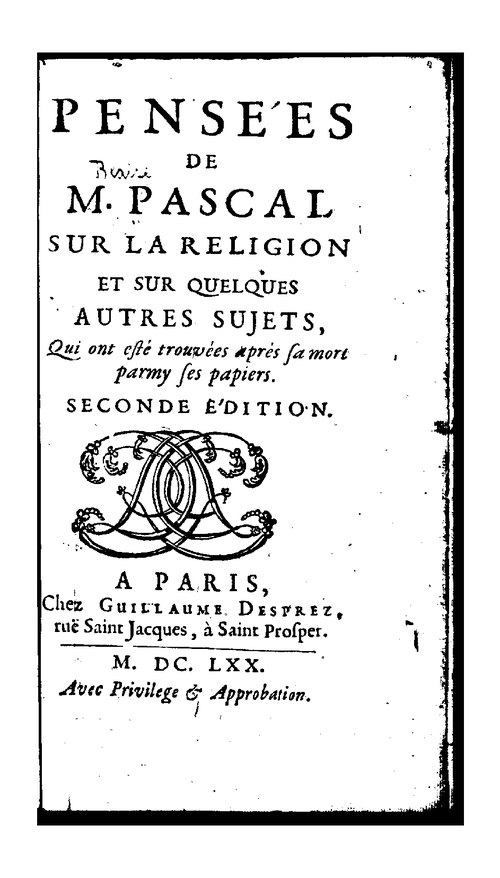 Pensées
"The Catholic religion does not bind us to confess our sins indiscriminately to everybody; it allows them to remain hidden from all other men save one, to whom she bids us reveal the innermost recesses of our heart, and show ourselves as we are. There is only this one man in the world whom she orders us to undeceive, and she binds him to an inviolable secrecy, which makes this knowledge to him as if it were not. Can we imagine anything more charitable and pleasant? And yet the corruption of man is such that he finds even this law harsh; and it is one of the main reasons which has caused a great part of Europe to rebel against the Church. How unjust and unreasonable is the heart of man, which feels it disagreeable to be obliged to do in regard to one man what in some measure it were right to do to all men! For is it right that we should deceive men?"
The Pensées (Thoughts) is a collection of fragments written by the French 17th-century philosopher and mathematician Blaise Pascal. Pascal's religious conversion led him into a life of asceticism, and the Pensées was in many ways his life's work. It represented Pascal's defense of the Christian religion, and the concept of "Pascal's wager" stems from a portion of this work.
"La vraie éloquence se moque de léloquence, la vraie morale se moque de la morale."
Pensées"...no one is offended at not seeing everything; but one does not like to be mistaken, and that perhaps arises from the fact that man naturally cannot see everything, and that naturally he cannot err in the side he looks at, since the perceptions of our senses are always true."
Pensées"There are then two kinds of intellect: the one able to penetrate acutely and deeply into the conclusions of given premises, and this is the precise intellect; the other able to comprehend a great number of premises without confusing them, and this is the mathematical intellect. The one has force and exactness, the other comprehension. Now the one quality can exist without the other; the intellect can be strong and narrow, and can also be comprehensive and weak."
Pensées"...it is to judgment that perception belongs, as science belongs to intellect. Intuition is the part of judgment, mathematics of intellect."
Pensées"Se moquer de la philosophie, cest vraiment philosopher"
Pensées"Scepticism.—I shall here write my thoughts without order, and not perhaps in unintentional confusion; that is the true order, which will always indicate my object by its very disorder. I should do too much honor to my subject, if I treated it with order, since I want to show that it is incapable of it."
Pensées