Quote
"Theorem of the equivalence of Heat and Work. ...Mechanical work may be transformed into heat, and conversely heat into work, the magnitude of the of the one being always proportional to that of the other."
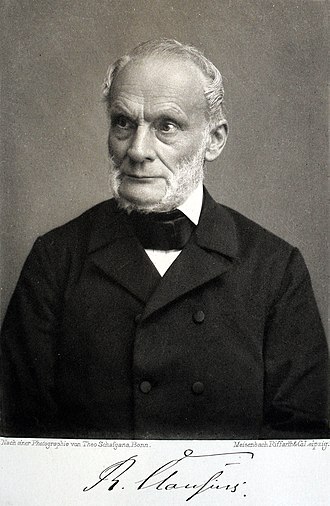 Rudolf Clausius
"The expression "a machine is driven by heat" is not... strictly accurate. ...[I]n consequence of the changes produced by heat upon ...matter in the machine, the parts ...are set in motion. ...[T]his matter ...[is] that which manifests the action of heat."
Rudolf Julius Emanuel Clausius was a German physicist and mathematician and is considered one of the central founding fathers of the science of thermodynamics. By his restatement of Sadi Carnot's principle known as the Carnot cycle, he gave the theory of heat a truer and sounder basis. His most important paper, "On the Moving Force of Heat", published in 1850, first stated the basic ideas of the s
"Theorem of the equivalence of Heat and Work. ...Mechanical work may be transformed into heat, and conversely heat into work, the magnitude of the of the one being always proportional to that of the other."
Rudolf Clausius"Carnot proves that whenever work is produced by heat... a... quantity of heat passes from a warm body to... cold... [e.g.,] the vapour... generated in the of a steam-engine... passes... to the condenser where it is precipitated... This transmission Carnot regards as the change of heat corresponding to the work... He says... no heat is lost in the process, that... [its] quantity remains unchanged; and he adds, "This is a fact... never... disputed... confirmed by various calorimetric experiments. To deny it, would be to reject the entire theory of heat, of which it forms the principal foundation.""
Rudolf Clausius"In their calculations, Clausius (and Waterston, for that matter) had imagined all atoms in a gas moving at the same speed. They knew this wasnt true... but they didnt have the mathematical sophistication to tackle the full problem. Maxwell... defined a mathematical function called the distribution of velocities, which kept track of how many atoms were moving at any particular speed relative to the average, and by dealing in terms of this distribution... was able to give his calculations a precision that those of Clausius lacked."
Rudolf Clausius"[T]he equivalence-value of the transformation of work into the quantity of heat Q, of the temperature t, may be represented... wherein f(t) is...[the same] function of the temperature... for all cases. When Q is negative... it will indicate that the quantity... transformed... from heat into work."
Rudolf Clausius"The careful experiments of Joule, who developed heat... by the application of mechanical force, establish... not only the possibility of increasing the quantity of heat, but also the fact that the newly-produced heat is proportional to the work expended in its production."
Rudolf Clausius"[T]he new theory is opposed, not to the real fundamental principle of Carnot, but to the addition "no heat is lost;" for it is... possible that in the production of work... a certain portion of heat may be consumed, and a further portion transmitted from a warm body to a cold one; and both portions may stand in a certain definite relation to the quantity of work produced."
Rudolf Clausius