Quote
"The constitution does not provide for first and second class citizens."
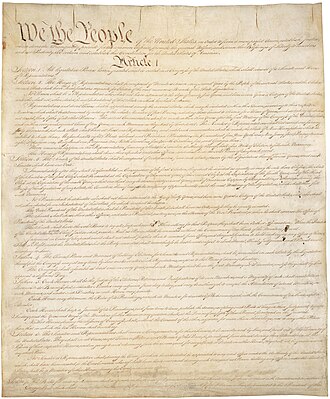 United States Constitution
"The old Soviet constitution created a right to secede. The United States Constitution does not. Although some secessionists in the American South, invoking state sovereignty, claimed to find an implicit right to secede in the founding document, it was more common to invoke an extra-textual right to secede said to be enshrined in the Declaration of Independence. In any case, no serious scholar or politician now argues that a right to secede exists under United States constitutional law. It is generally agreed that such a right would undermine the spirit of the original document, one that encourages the development of constitutional provisions that prevent the defeat of the basic enterprise of democratic self-government."
The Constitution of the United States is the supreme law of the United States of America. It superseded the Articles of Confederation, the nation's first constitution, on March 4, 1789. Originally including seven articles, the Constitution defined the foundational structure of the federal government.
"The constitution does not provide for first and second class citizens."
United States Constitution"The judicial Power of the United States, shall be vested in one supreme Court, and in such inferior Courts as the Congress may from time to time ordain and establish. The Judges, both of the supreme and inferior Courts, shall hold their Offices during good Behaviour, and shall, at stated Times, receive for their Services, a Compensation, which shall not be diminished during their Continuance in Office."
United States Constitution"When this nation was in trouble, in its early struggles, it looked upon the Negro as a citizen. In 1776 he was a citizen. At the time of the formation of the Constitution the Negro had the right to vote in eleven States out of the old thirteen. In your trouble you have made us citizens. In 1812 General Jackson addressed us as citizens; fellow-citizens. He wanted us to fight. We were citizens then! And now, when you come to frame a conscription bill, the Negro is a citizen again. He has been a citizen just three times in the history of this government, and it has always been in time of trouble. In time of trouble we are citizens. Shall we be citizens in war, and aliens in peace? Would that be just?"
United States Constitution"The Constitution is not a panacea for every blot upon the public welfare, nor should this Court, ordained as a judicial body, be thought of as a general haven for reform movements."
United States Constitution"Treason against the United States, shall consist only in levying war against them, or in adhering to their enemies, giving them aid and comfort. No person shall be convicted of treason unless on the testimony of two witnesses to the same overt act, or on the confession in open court."
United States Constitution"I sincerely rejoice at the acceptance of our new Constitution by nine States. It is a good canvas, on which some strokes only want retouching. What these are, I think are sufficiently manifested by the general voice from north to south, which calls for a bill of rights."
United States Constitution"The smart way to keep people passive and obedient is to strictly limit the spectrum of acceptable opinion, but allow very lively debate within that spectrum - even encourage the more critical and dissident views. That gives people the sense that theres free thinking going on, while all the time the presuppositions of the system are being reinforced by the limits put on the range of the debate."
"There is no ethical idea which it [dharma] has not stressed, put in its most ideal and imperative form, enforced by teaching, injunction, parable, artistic creation, formative examples. Truth, honour, loyalty, fidelity, courage, chastity, love, long-suffering, self-sacrifice, harmlessness, forgiveness, compassion, benevolence, beneficence are its common themes, are, in its view, the very stuff of a right human life, the essence of mans dharma. Buddhism, with its high and noble ethics, Jainism, with its austere ideal of self-conquest, Hinduism, with its magnificent examples of all sides of the Dharma, are not inferior in ethical teaching and practice to any religion or system, but rather take the highest rank and have had the strongest effective force."
"Moving forward will not be for the faint of heart. But if the next century witnesses failure, let it be because our science is not yet up to the job, not because we dont have the courage to make less random the sometimes most unfair courses of human evolution."
"Our units of temporal measurement, from seconds on up to months, are so complicated, asymmetrical and disjunctive so as to make coherent mental reckoning in time all but impossible. Indeed, had some tyrannical god contrived to enslave our minds to time, to make it all but impossible for us to escape subjection to sodden routines and unpleasant surprises, he could hardly have done better than handing down our present system. It is like a set of trapezoidal building blocks, with no vertical or horizontal surfaces, like a language in which the simplest thought demands ornate constructions, useless particles and lengthy circumlocutions. Unlike the more successful patterns of language and science, which enable us to face experience boldly or at least level-headedly, our system of temporal calculation silently and persistently encourages our terror of time. ... It is as though architects had to measure length in feet, width in meters and height in ells; as though basic instruction manuals demanded a knowledge of five different languages. It is no wonder then that we often look into our own immediate past or future, last Tuesday or a week from Sunday, with feelings of helpless confusion."
"We must present democracy as a force holding within itself the seeds of unlimited progress by the human race. By our actions we should make it clear that such a democracy is a means to a better way of life, together with a better understanding among nations. Tyranny inevitably must retire before the tremendous moral strength of the gospel of freedom and self-respect for the individual, but we have to recognize that these democratic principles do not flourish on empty stomachs, and that people turn to false promises of dictators because they are hopeless and anything promises something better than the miserable existence that they endure. However, material assistance alone is not sufficient. The most important thing for the world today in my opinion is a spiritual regeneration which would reestablish a feeling of good faith among men generally. Discouraged people are in sore need of the inspiration of great principles. Such leadership can be the rallying point against intolerance, against distrust, against that fatal insecurity that leads to war. It is to be hoped that the democratic nations can provide the necessary leadership."
"James Baker was the only leader in America who had the guts to stand up and act against Israels malignant disease: the settlements. When he was the Secretary of State, he simply informed the Israeli government that he would deduct the sums expended on the settlements from the money Israel was getting from the US. Threatened and made good on his threat. Baker thus confronted the "pro-Israeli" lobby in the US, both the Jewish and the Christian. Such courage is rare in the United States, as it is rare in Israel."