SHAWORDS

The Russian Revolution really has two interwoven histories: its impact — Eric Hobsbawm

"The Russian Revolution really has two interwoven histories: its impact on Russia and its impact on the world. We must not confuse the two. Without the second, few except a handful of specialist historians would ever have been concerned with it. Outside the USA not many people know more about the American Civil War than that it is the setting of Gone with the Wind. And yet it was both the greatest war between 1815 and 1914 and by far the greatest in American history, and can also claim to have been something like a second American revolution. It meant and means much inside the USA but very little outside, for it had very little obvious effect on what happened in other countries, other than those beyond its southern borders. On the other hand, both in Russian history and in twentieth-century world history the Russian Revolution is a towering phenomenon - but not the same kind of phenomenon. What has it meant for the Russian peoples? It brought Russia to the peak of its international power and prestige - far beyond anything achieved under the Tsars. Stalin is as certain of a major permanent place in Russian history as Peter the Great. It modernized much of a backward country, but although its achievements were titanic - not least the ability to defeat Germany in the Second World War - their human cost was enormous, its dead-end economy was destined to run down and its political system broke down. Admittedly, for most of its inhabitants who can remember, the old Soviet era certainly looks far better than what the former Soviet peoples are going through now, and will go on doing so for a good long while. But it is too early to draw up a historical balance-sheet."
E
Eric Hobsbawm
Eric Hobsbawm
author91 quotes

Eric John Ernest Hobsbawm was a British historian of the rise of industrial capitalism, socialism and nationalism. His best-known works include his tetralogy about what he called the "long 19th century" and the "short 20th century", and an edited volume that introduced the influential idea of "invented traditions". He was a life-long Marxist, and his socio-political convictions influenced the char

More by Eric Hobsbawm

View all →
Quote
"Much less useful, I think however, is the search for deep structures and particularly the search for la conscience. I may be entirely heterodox, but I dont think historians have an awful lot to learn from Freud, who was a bad historian, whenever he actually wrote anything about history. I have no opinions about Freuds psychology, but I regard the belated discovery of Freud in France some forty years after the rest of the world as by no means an unqualified plus. It seems to me it is a minus, insofar as it diverts attention into the unconscious or deep structures from, I wont say conscious, but anyway logical cohesion. It neglects system. It seems to me the problem of mentalities is not simply that of discovering that people are different, and how they are different, and making readers feel the difference, as Richard Cobb does so well. It is to find a logical connection between various forms of behaviour, of thinking and feeling, to see them as being mutually consistent. It is, if you like, to see why it makes sense, let us say, for people to believe about famous robbers that they are invisible and invulnerable, even though they obviously are not. We must see such beliefs not purely as an emotional reaction but as part of a coherent system of beliefs about society, about the role of those who believe, and the role of those about whom the beliefs are held."
E
Eric Hobsbawm
Quote
"Look at London. Of course it matters to all of us that Londons economy flourishes. But the test of the enormous wealth generated in patches of the capital is not that it contributed 20%-30% to Britains GDP but how it affects the lives of the millions who live and work there. What kind of lives are available to them? Can they afford to live there? If they cant, it is not compensation that London is also a paradise for the ultra-rich. Can they get decently paid jobs or jobs at all? If they cant, dont brag about all those Michelin-starred restaurants and their self-dramatising chefs. Or schooling for children? Inadequate schools are not offset by the fact that London universities could field a football team of Nobel prize winners."
E
Eric Hobsbawm
Quote
"Nevertheless it is evident — if only from the Greek example just cited — that proto-nationalism, where it existed, made the task of nationalism easier, however great the differences between the two, insofar as existing symbols and sentiments of proto-national community could he mobilized behind a modern cause or a modern state. But this is far from saying that the two were the same, or even that one must logically or inevitably lead into the other. For it is evident that proto-nationalism alone is clearly not enough to form nationalities, nations, let alone states."
E
Eric Hobsbawm

More on Time

View all →
Quote
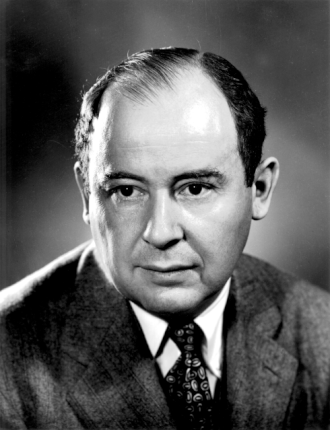
"Most mathematicians prove what they can, von Neumann proves what he wants." Once in a discussion about the rapid growth of mathematics in modern times, von Neumann was heard to remark that whereas thirty years ago a mathematician could grasp all of mathematics, that is impossible today. Someone asked him: "What percentage of all mathematics might a person aspire to understand today?" Von Neumann went into one of his five-second thinking trances, and said: "About 28 percent."
John von NeumannJohn von Neumann