Quote
"If there is one single area of economics in which path dependence is unmistakable, it is in economic geography – the location of production in space."
P
Paul Krugman"The usual and basic Keynesian answer to recessions is a monetary expansion. But Keynes worried that even this might sometimes not be enough, particularly if a recession had been allowed to get out of hand and become a true depression. Once the economy is deeply depressed, households and especially firms may be unwilling to increase spending no matter how much cash they have, they may simply add any monetary expansion to their board. Such a situation, in which monetary policy has become ineffective, has come to be known as a ""; Keynes believed that the British and American economies had entered such a trap by the mid-1930s, and some economists believed that the United States was on the edge of such a trap in 1992. The Keynesian answer to a liquidity trap is for the government to do what the private sector will not: spend. When monetary expansion is ineffective, fiscal expansion—such as public works programs financed by borrowing—must take its place. Such a fiscal expansion can break the vicious circle of low spending and low incomes, "priming the pump: and getting the economy moving again. But remember that this is not by any means an all-purpose policy recommendation; it is essentially a strategy of desperation, a dangerous drug to be prescribed only when the usual over-the-counter remedy of monetary policy has failed."
Paul Robin Krugman is an American economist who is the Distinguished Professor of Economics at the Graduate Center of the City University of New York. He was a columnist for The New York Times from 2000 to 2024. In 2008, Krugman was the sole winner of the Nobel Memorial Prize in Economic Sciences for his contributions to new trade theory and new economic geography. The Prize Committee cited Krugma
"If there is one single area of economics in which path dependence is unmistakable, it is in economic geography – the location of production in space."
"In the course of describing my formative moment in 1978, I have already implicitly given my four basic rules for research. Let me now state them explicitly, then explain. Here are the rules:1. Listen to the Gentiles 2. Question the question 3. Dare to be silly 4. Simplify, simplify"
"If you want a simple model for predicting the unemployment rate in the United States over the next few years, here it is: It will be what Greenspan wants it to be, plus or minus a random error reflecting the fact that he is not quite God."
"But the honest truth is that what drives me as an economist is that economics is fun. I think I understand why so many people think that economics is a boring subject, but they are wrong. On the contrary, there is hardly anything I know that is as exciting as finding that the great events that move history, the forces that determine the destiny of empires and the fate of kings, can sometimes be explained, predicted, or even controlled by a few symbols on a printed page. We all want power, we all want success, but the ultimate reward is the simple joy of understanding."
"It is a bit funny, but also quite sad: Those who preach the doctrine of global glut are tilting at windmills, when there are some real monsters out there that need slaying."
"If there were an Economists Creed, it would surely contain the affirmations I understand the Principle of Comparative Advantage and I advocate Free Trade"
"In the life of the mass-order, the culture of the generality tends to conform to the demands of the average human being. Spirituality decays through being diffused among the masses when knowledge is impoverished in every possible way by rationalisation until it becomes accessible to the crude understanding of all."
"I say this to you because we Spaniards are a forgetful people, because we are used to living for the moment, because we do not look back, because we do not know how to see the chain of heroes, because we do not contemplate the sum of sacrifices."
 Francisco Franco
"Sharon Tate was my best friend. Once, we were roommates. She introduced me to my husband. She was the godmother to my baby daughter who is named for her. In the six years time that I knew her, she never said an unkind word about anyone."
"Long time to see. (VS: Tapion)"
"Most mathematicians prove what they can, von Neumann proves what he wants." Once in a discussion about the rapid growth of mathematics in modern times, von Neumann was heard to remark that whereas thirty years ago a mathematician could grasp all of mathematics, that is impossible today. Someone asked him: "What percentage of all mathematics might a person aspire to understand today?" Von Neumann went into one of his five-second thinking trances, and said: "About 28 percent."
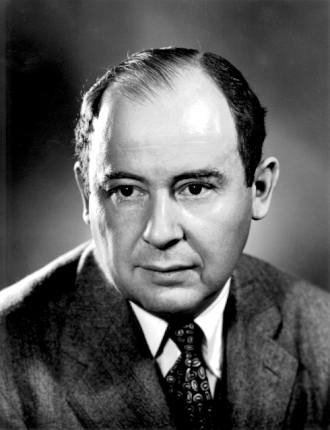 John von Neumann
"Children must be free to think in all directions irrespective of the peculiar ideas of parents who often seal their childrens minds with preconceived prejudices and false concepts of past generations. Unless we are very careful, very careful indeed, and very conscientious, there is still great danger that our children may turn out to be the same kind of people we are."