Quote
"The relevant equation is: Knowledge = power = energy = matter = mass; a good bookshop is just a genteel Black Hole that knows how to read. (p. 3)"
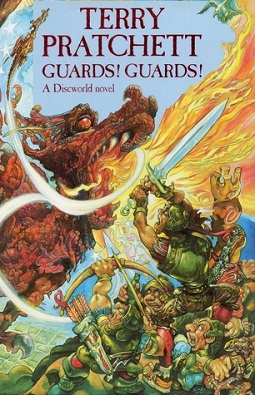 Guards! Guards!
"The Watch hadnt liked it, but the plain fact was that the thieves were far better at controlling crime than the Watch had ever been. After all, the Watch had to work twice as hard to cut crime just a little, whereas all the Guild had to do was to work less. (p. 45)"
Guards! Guards! is a fantasy novel by British writer Terry Pratchett, the eighth in the Discworld series, first published in 1989. It is the first novel about the Ankh-Morpork City Watch. The first Discworld point-and-click adventure game borrowed heavily from the plot of Guards! Guards!
"The relevant equation is: Knowledge = power = energy = matter = mass; a good bookshop is just a genteel Black Hole that knows how to read. (p. 3)"
Guards! Guards!"By and large medical assistance was nonexistent and people had to die inefficiently, without the aid of doctors. (p. 136)"
Guards! Guards!"Down there," he said, "are people who will follow any dragon, worship any god, ignore any iniquity. All out of a kind of humdrum, everyday badness. Not the really high, creative loathesomeness of the great sinners, but a sort of mass-produced darkness of the soul. Sin, you might say, without a trace of originality. They accept evil not because they say yes, but because they dont say no." (p. 337)"
Guards! Guards!"Disgusting, this sort of thing, really," mused Sergeant Colon. "People goin around in coaches like this when theres people with no roof to their heads."
Guards! Guards!"There was a thoughtful pause in the conversation as the assembled Brethren mentally divided the universe into the deserving and the undeserving, and put themselves on the appropriate side. (pp. 13-14)"
Guards! Guards!"Noble dragons dont have friends. The nearest they can get to the idea is an enemy who is still alive. (p. 188)"
Guards! Guards!"I, too, believed it was impossible to change the existing society into one that would be for the benefit of all; neither could I espouse any given ideal for society. But [...] I felt that even if one did not have an ideal vision of society, one could have one’s work to do. Whether it was successful or not was not our concern; it was enough that we believed it to be a valid work. The accomplishment of that work, I believed, was what our real life was about. Yes. I want to carry out a work of my own; for I feel that by so doing our lives are rooted in the here and now, not in some far-off ideal goal."
"Nobody should start to undertake a large project. You start with a small _trivial_ project, and you should never expect it to get large. If you do, youll just overdesign and generally think it is more important than it likely is at that stage. Or worse, you might be scared away by the sheer size of the work you envision. So start small, and think about the details. Dont think about some big picture and fancy design. If it doesnt solve some fairly immediate need, its almost certainly over-designed. And dont expect people to jump in and help you. Thats not how these things work. You need to get something half-way _useful_ first, and then others will say "hey, that _almost_ works for me", and theyll get involved in the project."
 Free software
"If something seems possible, thats probably because someone is already doing it. When something seems that it cant possibly work, nobody tries it. Real innovation happens when someone tries anyway, overlooking an obvious flaw, and finds a way to make an idea work."
"Without getting complicated let me recapitulate my art training in the following way: the Academy first, the break with the Academy when I hit the Hofmann School which is Cubist. The next real break follows when I see Pollock’s work [1940-41] and once more another transition occurs.. .It was a force [Pollock’s work], a living force, the same sort of thing I responded to in Matisse, in Picasso, in Mondrian. Once more, I was hit that hard with what I saw... I began feeling the need to break with what I was doing and to approach something else."
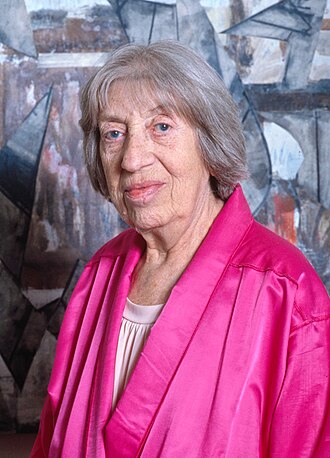 Lee Krasner
"Well I think it [a Little Image painting] does suggest hieroglyphics of some sort. It is a preoccupation of mine from way back and every once in a while it comes into my work again. For instance in my 1968 show at the Marlborough I have a painting called Kufic, an ancient form of Arabic writing. Every once in a while I fall back to what I call my mysterious writings. I haven no idea what this is about but it runs through periods of my work."
Lee Krasner"Action in its essence, the creative art of a writer of fiction may be compared to rescue work carried out in darkness against cross gusts of wind swaying the action of a great multitude. It is rescue work, this snatching of vanishing phases of turbulence, disguised in fair words, out of the native obscurity into a light where the struggling forms may be seen, seized upon, endowed with the only possible form of permanence in this world of relative values — the permanence of memory."