Quote
"To science, not even the bark of a tree or a drop of pond water is dull or a handful of dirt banal. They all arouse awe and wonder."
J
Jane Jacobs"This is both a gloomy and a hopeful book. The subject itself is gloomy. A Dark Age is a cultures dead end. We in North America and Western Europe, enjoying the many benefits of the culture conventionally known as the West, customarily think of a Dark Age as happening once, long ago, following the collapse of the Western Roman Empire. But in North America we live in a graveyard of lost aboriginal cultures, many of which were decisively finished off by mass amnesia in which even the memory of what was lost was also lost. Throughout the world Dark Ages have scrawled finis to successions of cultures receding far into the past."
Jane Isabel Jacobs was an American-Canadian journalist, author, theorist, and activist who influenced urban studies, sociology, and economics. Her book The Death and Life of Great American Cities (1961) argued that "urban renewal" and "slum clearance" did not respect the needs of city-dwellers.
"To science, not even the bark of a tree or a drop of pond water is dull or a handful of dirt banal. They all arouse awe and wonder."
"I would spend a nickel on the subway and go arbitrarily to some other stop and look around there. So I was roaming the city in the afternoons and applying for jobs in the morning. And one day I found myself in a neighborhood I just liked so much…it was one of those times I had put a nickel in and just invested something. And where did I get out? I just liked the sound of the name: Christopher Street — so I got out at Christopher Street, and I was enchanted with this neighborhood, and walked around it all afternoon and then I rushed back to Brooklyn. And I said, "Betty I found out where we have to live."
"I did have an inkling that I was going to be a writer. That was my intention."
"I was brought up to believe that there is no virtue in conforming meekly to the dominant opinion of the moment. I was encouraged to believe that simple conformity results in stagnation for a society, and that American progress has been largely owing to the opportunity for experimentation, the leeway given initiative, and to a gusto and a freedom for chewing over odd ideas."
"I was taught that the Americans right to be a free individual, not at the mercy of the state, was hard-won and that its price was eternal vigilance, that I too would have to be vigilant. I was made to feel that it would be a disgrace to me, as an individual, if I should not value or should give up rights that were dearly bought. I am grateful for that upbringing."
"Writing, printing, and the Internet give a false sense of security about the permanence of culture."
"In the life of the mass-order, the culture of the generality tends to conform to the demands of the average human being. Spirituality decays through being diffused among the masses when knowledge is impoverished in every possible way by rationalisation until it becomes accessible to the crude understanding of all."
"I say this to you because we Spaniards are a forgetful people, because we are used to living for the moment, because we do not look back, because we do not know how to see the chain of heroes, because we do not contemplate the sum of sacrifices."
 Francisco Franco
"Sharon Tate was my best friend. Once, we were roommates. She introduced me to my husband. She was the godmother to my baby daughter who is named for her. In the six years time that I knew her, she never said an unkind word about anyone."
"Long time to see. (VS: Tapion)"
"Most mathematicians prove what they can, von Neumann proves what he wants." Once in a discussion about the rapid growth of mathematics in modern times, von Neumann was heard to remark that whereas thirty years ago a mathematician could grasp all of mathematics, that is impossible today. Someone asked him: "What percentage of all mathematics might a person aspire to understand today?" Von Neumann went into one of his five-second thinking trances, and said: "About 28 percent."
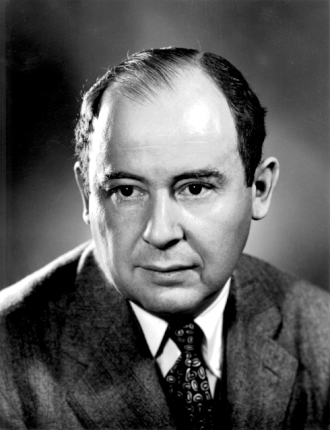 John von Neumann
"Children must be free to think in all directions irrespective of the peculiar ideas of parents who often seal their childrens minds with preconceived prejudices and false concepts of past generations. Unless we are very careful, very careful indeed, and very conscientious, there is still great danger that our children may turn out to be the same kind of people we are."