Quote
"The greatest danger to our future is apathy. We cannot expect those living in poverty and ignorance to worry about saving the world. For those of us able to read this magazine, it is different. We can do something to preserve our planet."
"This very real difference between GM plants and their conventional counterparts is one of the basic truths that biotech proponents have endeavoured to obscure. As part of the process, they portrayed the various concerns as merely the ignorant opinions of misinformed individuals – and derided them as not only unscientific, but anti-science."

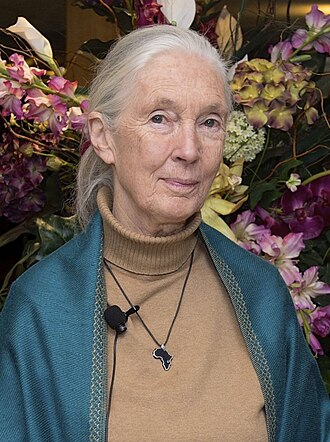
Dame Valerie Jane Morris Goodall was an English primatologist and anthropologist. Regarded as a pioneer in primate ethology, and described by many publications as "the world's preeminent chimpanzee expert", she was best known for more than six decades of field research on the social and family life of wild chimpanzees in the Kasakela chimpanzee community at Gombe Stream National Park in Tanzania.
"The greatest danger to our future is apathy. We cannot expect those living in poverty and ignorance to worry about saving the world. For those of us able to read this magazine, it is different. We can do something to preserve our planet."
"Understanding what chimpanzees are like has made me realize that we humans are not so different from other animals as we used to think. What makes us most different is that we are far more clever than even the cleverest chimp, and we have words. We have a spoken language. We can tell stories about what happened a week or a year or a decade ago. We can plan for the future, and we can discuss things - one persons idea can grow and change as other people contribute their ideas. Great ideas become greater, problems are solved."
"Only if we understand can we care. Only if we care will we help. Only if we help shall they be saved."
"Every individual matters. Every individual has a role to play. Every individual makes a difference."
"The long hours spent with them in the forest have enriched my life beyond measure. What I have learned from them has shaped my understanding of human behavior, of our place in nature."
"But let us not forget that human love and compassion are equally deeply rooted in our primate heritage, and in this sphere too our sensibilities are of a higher order of magnitude than those of chimpanzees."
"We have created a wealthy society with tens of millions of talented, resourceful individuals who play virtually no role whatsoever as citizens. Bringing these people in — with their networks of influence, their knowledge, and their resources — is the key to creating the capacity for shared intelligence that we need to solve our problems."
"As in respect of the first wonder we are all on the same level, how comes it that the philosophic mind should, in all ages, be the privilege of a few? The most obvious reason is this: The wonder takes place before the period of reflection, and (with the great mass of mankind) long before the individual is capable of directing his attention freely and consciously to the feeling, or even to its exciting causes. Surprise (the form and dress which the wonder of ignorance usually puts on) is worn away, if not precluded, by custom and familiarity."
"The dualistic philosophy reigned supreme in Europe, dominating the development of Western science. But with the advent of atomic physics, findings based on demonstrable experiment were seen to negate the dualistic theory, and the trend of thought since then has been back to the monistic conception of the ancient Taoists."
"Under the rule of a repressive whole, liberty can be made into a powerful instrument of domination. The range of choice open to the individual is not the decisive factor in determining the degree of human freedom, but what can be chosen and what is chosen by the individual."
"All economic activity is carried out through time. Every individual economic process occupies a certain time, and all linkages between economic processes necessarily involve longer or shorter periods of time."
"I believe that the main lesson which our generation has learnt is that we must find a new limit for the activities of government, a limit which leaves ample scope for sensible experimentation but which secures the freedom of the individual as the mainspring of all social and political activity. The whole purpose of these lectures has been to suggest that we can find such a limit if we are willing to revive and develop the ancient ideal of the Rule of Law."