Quote
"But let us not forget that human love and compassion are equally deeply rooted in our primate heritage, and in this sphere too our sensibilities are of a higher order of magnitude than those of chimpanzees."
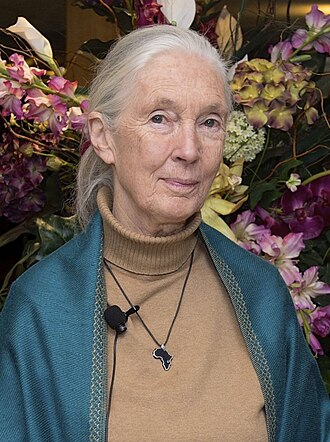 Jane Goodall
Jane Goodall
Jane Goodall
Dame Valerie Jane Morris Goodall was an English primatologist and anthropologist. Regarded as a pioneer in primate ethology, and described by many publications as "the world's preeminent chimpanzee expert", she was best known for more than six decades of field research on the social and family life of wild chimpanzees in the Kasakela chimpanzee community at Gombe Stream National Park in Tanzania.
"But let us not forget that human love and compassion are equally deeply rooted in our primate heritage, and in this sphere too our sensibilities are of a higher order of magnitude than those of chimpanzees."
Jane Goodall"The greatest danger to our future is apathy. We cannot expect those living in poverty and ignorance to worry about saving the world. For those of us able to read this magazine, it is different. We can do something to preserve our planet."
Jane Goodall"Understanding what chimpanzees are like has made me realize that we humans are not so different from other animals as we used to think. What makes us most different is that we are far more clever than even the cleverest chimp, and we have words. We have a spoken language. We can tell stories about what happened a week or a year or a decade ago. We can plan for the future, and we can discuss things - one persons idea can grow and change as other people contribute their ideas. Great ideas become greater, problems are solved."
Jane Goodall"Only if we understand can we care. Only if we care will we help. Only if we help shall they be saved."
Jane Goodall"Every individual matters. Every individual has a role to play. Every individual makes a difference."
Jane Goodall"The long hours spent with them in the forest have enriched my life beyond measure. What I have learned from them has shaped my understanding of human behavior, of our place in nature."
Jane Goodall"We cant leave people in abject poverty, so we need to raise the standard of living for 80% of the worlds people, while bringing it down considerably for the 20% who are destroying our natural resources."
Jane Goodall"Well, in some ways we’re not successful at all. We’re destroying our home. That’s not a bit successful. Chimpanzees, gorillas, orangutans have been living for hundreds of thousands of years in their forest, living fantastic lives, never overpopulating, never destroying the forest. I would say that they have been in a way more successful than us as far as being in harmony with the environment."
Jane Goodall"Change happens by listening and then starting a dialogue with the people who are doing something you dont believe is right."
Jane Goodall"Anyone who tries to improve the lives of animals invariably comes in for criticism from those who believe such efforts are misplaced in a world of suffering humanity."
Jane Goodall"As I traveled, talking about these issues, I met so many young people who had lost hope. Some were depressed; some were apathetic; some were angry and violent. And when I talked to them, they all more or less felt this way because we had compromised their future and the world of tomorrow was not going to sustain their great-grandchildren."
Jane Goodall"The most important thing is to actually think about what you do. To become aware and actually think about the effect of what you do on the environment and on society. Thats key, and that underlies everything else."
Jane Goodall




