Quote
"Hindu are more exact in astronomy and astrology than any other people."
V
Vedic science"Two thousand years before Pythagoras, philosophers in northern India had understood that gravitation held the solar system together, and that therefore the sun, the most massive object, had to be at its center." "Twenty-four centuries before Isaac Newton, the Hindu Rig-Veda asserted that gravitation held the universe together. The Sanskrit speaking Aryans subscribed to the idea of a spherical earth in an era when the Greeks believed in a flat one. The Indians of the fifth century A.D. calculated the age of the earth as 4.3 billion years; scientists in 19th century England were convinced it was 100 million years."
Vedic science refers to a pseudoscientific system of knowledge based on the Vedas, a large body of religious texts originating in ancient India.
"Hindu are more exact in astronomy and astrology than any other people."
"The Hindu religion is the only one of the worlds great faiths dedicated to the idea that the Cosmos itself undergoes an immense, indeed an infinite, number of deaths and rebirths. It is the only religion in which the time scales correspond, no doubt by accident [this part of the quote is often left out], to those of modern scientific cosmology. Its cycles run from our ordinary day and night to a day and night of Brahma, 8.64 billion years long. Longer than the age of the Earth or the Sun and about half the time since the Big Bang. And there are much longer time scales still."
"Hindu cosmography, for example born in hoary antiquity, strikes one in certain ways as surprisingly modern. India has never limited its conception of time to a few crowded millennia. Thousands of years ago Indias sages computed the earths age at a little over two billion years, our present era being what is called the seventh Manuvantra. This is a staggering claim. Consider how much scientific evidence has been needed in the West before men could even imagine so enormous a time scale."
"Ages before Lamarck and Darwin it was held in India that man has passed through 84 lakhs (8,400,000) of birth as plants, animals, as an "inferior species of man" and then as the ancestor of the developed type existing to-day. The theory was not, like modern doctrine of evolution, based wholly on observation and a scientific enquiry into fact but was a rather (as some other matters) an act of brilliant intuition in which observation may also have had some part."
"To the philosophers of India, however, Relativity is no new discovery, just as the concept of light years is no matter for astonishment to people used to thinking of time in millions of kalpas, (A kalpa is about 4,320,000 years). The fact that the wise men of India have not been concerned with technological applications of this knowledge arises from the circumstance that technology is but one of innumerable ways of applying it."
"The Rig-Veda, is the first Indian literature to set down ideas resembling universal natural laws. Cosmic law is connected with cosmic light, with gods, and, later, specifically with Brahman. It was the Vedic Aryans... who gave the world some of the earliest philosophical texts on the makeup of matter and the theoretical underpinnings for the chemical makeup of minerals. Sanskrit Vedas from thousands of years before Christ implied that matter could not be created, and that the universe had created itself."
"In the life of the mass-order, the culture of the generality tends to conform to the demands of the average human being. Spirituality decays through being diffused among the masses when knowledge is impoverished in every possible way by rationalisation until it becomes accessible to the crude understanding of all."
"I say this to you because we Spaniards are a forgetful people, because we are used to living for the moment, because we do not look back, because we do not know how to see the chain of heroes, because we do not contemplate the sum of sacrifices."
 Francisco Franco
"Sharon Tate was my best friend. Once, we were roommates. She introduced me to my husband. She was the godmother to my baby daughter who is named for her. In the six years time that I knew her, she never said an unkind word about anyone."
"Long time to see. (VS: Tapion)"
"Most mathematicians prove what they can, von Neumann proves what he wants." Once in a discussion about the rapid growth of mathematics in modern times, von Neumann was heard to remark that whereas thirty years ago a mathematician could grasp all of mathematics, that is impossible today. Someone asked him: "What percentage of all mathematics might a person aspire to understand today?" Von Neumann went into one of his five-second thinking trances, and said: "About 28 percent."
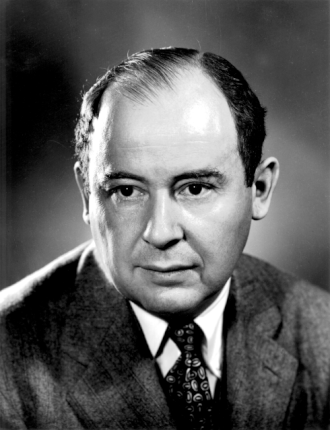 John von Neumann
"Children must be free to think in all directions irrespective of the peculiar ideas of parents who often seal their childrens minds with preconceived prejudices and false concepts of past generations. Unless we are very careful, very careful indeed, and very conscientious, there is still great danger that our children may turn out to be the same kind of people we are."