SHAWORDS

We all know nations that can be identified by the flight of writers fr — Toni Morrison

"We all know nations that can be identified by the flight of writers from their shores. These are regimes whose fear of unmonitored writing is justified because truth is trouble. It is trouble for the warmonger, the torturer, the corporate thief, the political hack, the corrupt justice system, and for a comatose public. Unpersecuted, unjailed, unharrassed writers are trouble for the ignorant bully, the sly racist, and the predators feeding off the world’s resources. The alarm, the disquiet, writers raise is instructive because it is open and vulnerable, because if unpoliced it is threatening. Therefore the historical suppression of writers is the earliest harbinger of the steady peeling away of additional rights and liberties that will follow."
Toni Morrison
Toni Morrison
Toni Morrison
author118 quotes

Chloe Anthony Wofford "Toni" Morrison was an American novelist and editor. She was awarded the Nobel Prize in Literature in 1993. Her first novel, The Bluest Eye, was published in 1970. The critically acclaimed Song of Solomon (1977) brought her national attention and won the National Book Critics Circle Award. In 1988, Morrison won the Pulitzer Prize for Beloved (1987).

More by Toni Morrison

View all →
Quote
"Except for an occasional request for color she said practically nothing — until the afternoon of the last day of her life when she got out of bed, skipped slowly to the door of the keeping room and announced to Sethe and Denver the lesson se had learned from her sixty years a slave and ten years free: that there was no bad luck in the world but whitepeople. "They dont know when to stop," she said, and returned to her bed, pulled up the quilt and left them to hold that thought forever."
Toni MorrisonToni Morrison
Quote
"It would seem that to continue to see race of people, any race of people as one single personality is an ignorance of gothic proportions, an ignorance so vast, so public, and perception so blind and so blunted, imagination so bleak that no nuance, no subtlety, no difference among them can be ascertained. Which may explain in part why in 1975 we are left with pretty much the same mental equipment we had in 1775 — the equipment that hadn’t the curiosity to record the names of human beings in a ship’s manifest, hasn’t the curiosity to examine the medieval minds of scientific racists, theologic [sic] racists, historical racists, literary racists; an intelligence that is so crippled that it could in all seriousness ask W.E.B. Du Bois, in 1905, in pursuit of some study as a White professor from Clark University did, whether colored people shed tears."
Toni MorrisonToni Morrison
Quote
"Pretty woman, he thought. Pretty little black-skinned woman. Who wanted to kill for love, die for love. The pride, the conceit of these doormat women amazed him. They were always women who had been spoiled children. Whose whims had been taken seriously by adults and who grew up to be the stingiest, greediest people on earth and out of their stinginess grew their stingy little love that ate everything in sight. They could not believe or accept the fact that they were unloved; they believed that the world itself was off balance when it appeared as though they were not loved. Why did they think they were so lovable? Why did they think their brand of love was better than, or even as good as, anybody elses? But they did. And they loved their love so much they would kill anybody who got in its way."
Toni MorrisonToni Morrison
Quote
"When he stood up from the supper table at 124 and turned toward the stairs, nausea was first, then repulsion. He, he. He who had eaten raw meat barely dead, who under plum trees bursting with blossoms had crunched through a doves breast before its heart stopped beating. Because he was a man and a man could do what he would: be still of six hours in a dry well while night dropped; fight raccoon with his hands and win; watch another man, just so the roasters would know what a man was like. And it was he, that man, who had walked from Georgia to Delaware, who could not go or stay put where he wanted to in 124 — shame."
Toni MorrisonToni Morrison

More on Time

View all →
Quote
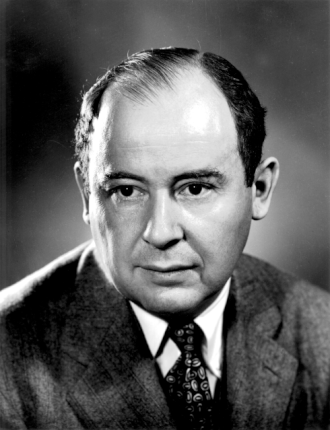
"Most mathematicians prove what they can, von Neumann proves what he wants." Once in a discussion about the rapid growth of mathematics in modern times, von Neumann was heard to remark that whereas thirty years ago a mathematician could grasp all of mathematics, that is impossible today. Someone asked him: "What percentage of all mathematics might a person aspire to understand today?" Von Neumann went into one of his five-second thinking trances, and said: "About 28 percent."
John von NeumannJohn von Neumann