Quote
"Since after extinction no one will be present to take responsibility, we have to take full responsibility now."
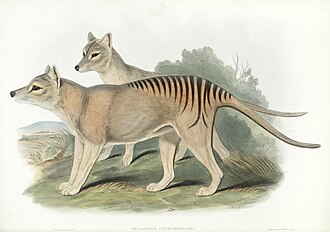 Extinction
"We already have a planet -- Earth! Right here! And its going to be here for at least another twenty years! Fifteen, if you use a plastic straw!"
Extinction is the termination of a species via the death of its last member. A taxon may become functionally extinct before the death of its last member if it loses the capacity to reproduce and recover. As a species' potential range may be very large, determining this moment is difficult, and is usually done retrospectively. This difficulty leads to phenomena such as Lazarus taxa, where a species
"Since after extinction no one will be present to take responsibility, we have to take full responsibility now."
Extinction"The human race currently consumes some 40% of the earth’s photosynthetic capacity. This monopoly on the earth’s resources is having a devastating effect. We are seeing the extinction of some 140 species every day, some thousands of times higher than the normal background rate. Today, right now, we are seeing extinction rates unparalleled in the history of the earth. We are undeniably in the midst of the seventh mass extinction event in the history of the earth — the Holocene Extinction. Unlikely previous extinction events, however, this one is driven by a single species. This is the true danger of overpopulation, not our inability to feed a growing population. As much as we would deny it, we depend on the earth to live. Dwindling biodiversity threatens the very survival of our species. We are literally cutting the ground out from under our feet. Increasing food production only increases the population; our current attitudes about food security has locked us into what Daniel Quinn called a “Food Race,” by comparison to the Arms Race of the Cold War."
Extinction"Nature cannot be destroyed. Sixty-five million years ago, an asteroid wiped out the dinosaurs, but in so doing opened the way forward for mammals. Today, humankind is driving many [if not all] species into extinction and might even annihilate itself. But other organisms are doing quite well. Rats and cockroaches, for example, are in their heyday. These tenacious creatures would probably creep out from beneath the smoking rubble of a nuclear Armageddon, ready and able to spread their DNA. Perhaps 65 million years from now, intelligent rats will look back gratefully on the decimation wrought by humankind, just as we today can thank that dinosaur-busting asteroid."
Extinction"…because of megafauna extinctions, being the only species to use fire, and the fact that an ability for symbolic representation and complex speech might be the recipe for a runaway species capable of rapid cultural evolution and technology development out of step with the rest of the community of life, and therefore maladapted to long-term co-existence in ecological relationship. If it looks like we’re winning the “battle against nature” right now, that’s actually what losing looks like."
Extinction"Lets not be too quick to blame the human race for everything. We must remember that a great many species of animals became extinct before man ever appeared on earth. At the same time it is probably true that when two husky representatives of Homo sapiens, with clubs, corner the last two birds of a species, no matter how far they have or have not evolved, both the phylogeny and the ontogeny of those birds are, to all intents and purposes, over."
Extinction"[We] cannot bring back species from extinction… We are still driving 150 species to oblivion daily… Collapse will not change anything in our attitudes. As long as humans remain genetically identical to who they are today, I’m afraid they will collapse again, and again, after this coming collapse, and probably risk complete extinction. This is not speculation, but simply looking at historical evidence: over thousands of years we have collapsed pretty much constantly—anthropologists have documented the collapse of more than 82 (!!!) civilisations. We are now at the stage of a systemic, global collapse because we are one, united global economic machine that has used up everything on the planet. Our species is wired for growth, and we are designed to go through boom-and-bust cycles. What comes after the next bust will be a significantly smaller civilisation… There will be another, smaller boom, then collapse again. With each collapse many… “species” risk disappearance."
Extinction