SHAWORDS

We must consider the words, "the heavens were opened" (Ezek. i. 1); th — Maimonides

HomeMaimonidesQuote
"We must consider the words, "the heavens were opened" (Ezek. i. 1); they give the key to the understanding of the whole. The figure of opening, also that of opening the gates, occurs frequently in the books of the prophets... When he commences to describe the firmament in detail, he says, "the firmament," without adding the words "the likeness of," for he says, "And I looked, and behold, in the firmament that was above the head of the cherubims there appeared over them as it were a sapphire stone, as the appearance of the likeness of a throne" (Ezek x. 1). Here the prophet speaks of "the firmament" and not of "the likeness of the firmament,"..."
Maimonides
Maimonides
Maimonides
author161 quotes

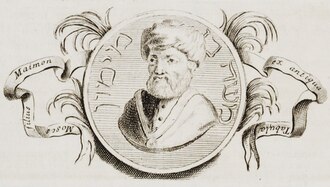
Moses ben Maimon, commonly known as Maimonides and also referred to by the Hebrew acronym Rambam, was a Sephardic Jewish rabbi who is widely acknowledged as one of the most prolific and influential Torah scholars of the Middle Ages. Originally from Córdoba, where he was born on Passover Eve of 1135 or 1138, his family was exiled from Muslim-ruled Spain when they refused to convert to Islam shortly

More by Maimonides

View all →
Quote
"Do not imagine that these most difficult problems can be thoroughly understood by any one of us. This is not the case. At times the truth shines so brilliantly that we perceive it as clear as day. Our nature and habit then draw a veil over our perception, and we return to a darkness almost as dense as before. We are like those who, though beholding frequent flashes of lightning, still find themselves in the thickest darkness of the night. On some the lightning flashes in rapid succession, and they seem to be in continuous light, and their night is as clear as the day. This was the degree of prophetic excellence attained by (Moses) the greatest of prophets, to whom God said," But as for thee, stand thou here by Me" (Deut. v. 31), and of whom it is written" the skin of his face shone," etc. (Exod. xxxiv. 29). [Some perceive the prophetic flash at long intervals; this is the degree of most prophets.] By others only once during the whole night is a flash of lightning perceived. This is the case with those of whom we are informed," They prophesied, and did not prophesy again" (Num. xi. 25). There are some to whom the flashes of lightning appear with varying intervals; others are in the condition of men, whose darkness is illumined not by lightning, but by some kind of crystal or similar stone, or other substances that possess the property of shining during the night; and to them even this small amount of light is not continuous, but now it shines and now it vanishes, as if it were" the flame of the rotating sword."
MaimonidesMaimonides
Quote
"There is one [disease] which is widespread, and from which men rarely escape. This disease varies in degree in different men … I refer to this: that every person thinks his mind … more clever and more learned than it is … I have found that this disease has attacked many an intelligent person … They … express themselves [not only] upon the science with which they are familiar, but upon other sciences about which they know nothing … If met with applause … so does the disease itself become aggravated."
MaimonidesMaimonides
Quote
"This [fourth] theory likewise implies contradictions and absurdities. The absurdities are these: The fact that some persons are born with defects, although they have not sinned previously, is ascribed to the wisdom of God, it being better for those persons to be in such a condition than to be in a normal state, though we do not see why it is better; and they do not suffer thereby any punishment at all, but, on the contrary, enjoy Gods goodness. In a similar manner the slaughter of the pious is explained as being for them the source of an increase in reward in future life. They go even further in their absurdities."
MaimonidesMaimonides

More on Books

View all →
Quote
"Perhaps the only true desire of mankind, coming thus to light in its hours of leisure, is to be set at rest. One is never set at rest by Mr. Henry Jamess novels. His books end as an episode in life ends. You remain with the sense of the life still going on; and even the subtle presence of the dead is felt in that silence that comes upon the artist-creation when the last word has been read. It is eminently satisfying, but it is not final. Mr. Henry James, great artist and faithful historian, never attempts the impossible."
H
Henry James (book)