SHAWORDS

When he left home at 17 to play in the minors in Alabama and Tennessee — Ty Cobb

HomeTy CobbQuote
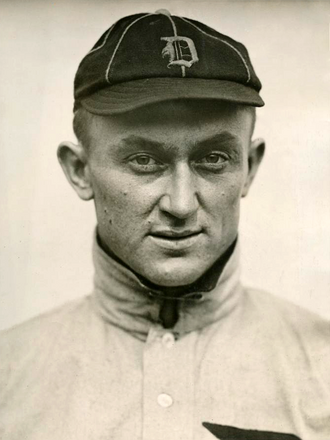
"When he left home at 17 to play in the minors in Alabama and Tennessee, his father warned him: "Dont come home a failure." "That admonition," Cobb recalled, "put more determination in me than he ever knew. My overwhelming need was to prove myself as a man."
Ty Cobb
Ty Cobb
Ty Cobb
author25 quotes

Tyrus Raymond Cobb, nicknamed "the Georgia Peach", was an American professional baseball center fielder. A native of rural Narrows, Georgia, Cobb played 24 seasons in Major League Baseball (MLB). He spent 22 years with the Detroit Tigers and served as the team's player-manager for the last six, and he finished his career with the Philadelphia Athletics. In 1936, Cobb received the most votes of any

More by Ty Cobb

View all →
Quote
"The incident illustrates a batting skill that every boy can acquire with practice- place-hitting. Place-hitters, also called choke hitters because they choke their grip on the bat, snap the stick with their forearms and punch the ball through any opening in the diamond which the infield may leave them. Cobb was probably the greatest place-hitter of them all with the possible exception of Willie Keeler, diminutive marvel of the old Baltimore Orioles, a star of an earlier era. I am going to refer frequently to Ty Cobb in this chapter because he was the greatest baseball player who ever lived."
Ty CobbTy Cobb
Quote
"Several years ago Ty Cobb, the veteran manager of the Detroit American League baseball team, put on his gray uniform and walked on the field at Yankee Stadium, New York City, an hour before a scheduled game between Detroit and New York. He was alert, aggressive and keen-eyed, nearing forty years of age. He had to walk past the New York dugout where the Worlds Champion Yankees were sitting. "Howdy, gentlemen," said Cobb. "Howdy yourself," retorted the Yankees. Then Urban shocker, Yankee pitcher, decided to have a little fun. "Isnt it time to take that uniform off, old man, and quit kidding the public?" he razzed. Cobb laughed tolerantly at this sally and went to the plate for hitting practice. "Hit one into left field," one of the Yankees shouted, and thereupon innocently precipitated an exhibition of baseball place-hitting that old-timers still talk about. "All right!" said Cobb. He promptly faced the hitting practice pitcher and drove a terrific liner into the left field stands. "Now one to center!" the Yankees yelled. "O.K.," replied Cobb, and timing the pitch beautifully, shot a grass-burner over second base. "Lets see you hit the next one to the right!" the New Yorkers dared and quick as lightning the Georgia Peach whipped a fast ball to the desired locality. "Now foul one into your dugout," the New York players called, jokingly. With a grim smile, Cobb fouled the next delivery, not into the Tiger dugout, but straight among the Yankees themselves, who tumbled over one another to avoid being hit by the ball. "Is that all for today, gentlemen?" Cobb asked."
Ty CobbTy Cobb

More on Home

View all →
Quote
"History is a strange experience. The world is quite small now; but history is large and deep. Sometimes you can go much farther by sitting in your own home and reading a book of history, than by getting onto a ship or an airplane and traveling a thousand miles. When you go to Mexico City through space, you find it a sort of cross between modern Madrid and modern Chicago, with additions of its own; but if you go to Mexico City through history, back only 500 years, you will find it as distant as though it were on another planet: inhabited by cultivated barbarians, sensitive and cruel, highly organized and still in the Copper Age, a collection of startling, of unbelievable contrasts."
G
Gilbert Highet
Quote
"The war was finished. It had lasted ten equivalent years and taken ten million lives. Thus it was neither of long duration nor of serious attrition. It hadnt any great significance; it was not intended to have. It did not prove a point, since all points had long ago been proven. What it did, perhaps, was to emphasize an aspect, sharpen a concept, underline a trend. On the whole it was a successful operation. Economically and ecologically it was of healthy effect, and who should grumble? And after wars, men go home. No, no, men start for home. Its not the same."
R
R. A. Lafferty