SHAWORDS

When I was young, Cebes, I had a prodigious desire to know the departm — Socrates

HomeSocratesQuote
"When I was young, Cebes, I had a prodigious desire to know the department of philosophy which is called Natural Science; this appeared to me to have lofty aims, as being the science which has to do with the causes of things, and which teaches why a thing is, and is created and destroyed; and I always agitated myself with the consideration of such questions as these... I went on to examine the decay of them, and then to the study of the heaven and earth, and at last I concluded that I was wholly incapable of these inquiries... There was a time when I thought that I understood the meaning of greater and less pretty well... that ten is more than eight, and that two cubits are more than one, because two is twice one. I should be far from imagining... that I knew the cause of any of them, indeed I should, for I cannot satisfy myself that when one is added to one, the one to which the addition is made becomes two... nor can I understand how the division of one is the way to make two; for then a different cause would produce the same effect."
S
Socrates
Socrates
author131 quotes

Socrates was an ancient Greek philosopher from Classical Athens, perhaps the first Western moral philosopher, and a major inspiration on his student Plato, who largely founded the tradition of Western philosophy. An enigmatic figure, Socrates authored no texts and is known mainly through the posthumous accounts of classical writers, particularly his students Plato and Xenophon. These accounts are

More on Time

View all →
Quote
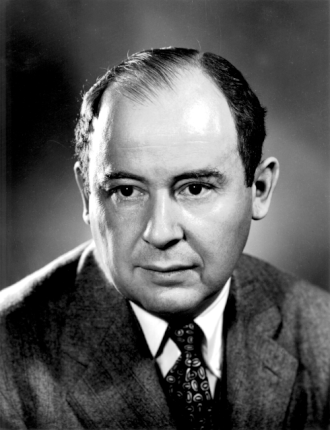
"Most mathematicians prove what they can, von Neumann proves what he wants." Once in a discussion about the rapid growth of mathematics in modern times, von Neumann was heard to remark that whereas thirty years ago a mathematician could grasp all of mathematics, that is impossible today. Someone asked him: "What percentage of all mathematics might a person aspire to understand today?" Von Neumann went into one of his five-second thinking trances, and said: "About 28 percent."
John von NeumannJohn von Neumann