SHAWORDS

When once the idea of the separate condensation was started, all these — Steam engine

HomeSteam engineQuote
"When once the idea of the separate condensation was started, all these improvements followed as corollaries in quick succession, so that in the course of one or two days the invention was thus far complete in my mind, and I immediately set about an experiment to verify it practically."
Steam engine
Steam engine
Steam engine
author17 quotes

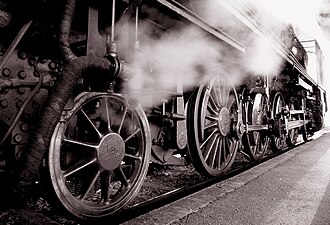
A steam engine is a heat engine that performs mechanical work using steam as its working fluid. The steam engine uses the force produced by steam pressure to push a piston back and forth inside a cylinder. This pushing force can be transformed by a connecting rod and crank into rotational force for work. The term “steam engine” is normally applied to reciprocating engines, although some authoritie

More by Steam engine

View all →
Quote
"Should the engine, to the apprehension of some, seem intricate and difficult to be worked, after all the description I have given of it in this book, yet I can, and do assure them, that the attending and working the engine is so far from being so, that it is familiar and easy to be learned by those of the meanest capacity, in a very little time; insomuch that I have boys of thirteen or fourteen years of age, who now attend and work it to perfection, and were taught to do it in a few days; and I have known some learn to work the engine in half an hour. We have a proverb, that interest never lies; and I am assured that you gentlemen of the mines and collieries, when you have once made this engine familiar in your works, and to yourselves and servants; not only the profit, but abundance of other advantages and conveniences which you will find to attend your works in the use thereof, will create in you a favourable opinion of the labours of Your real Friend and humble Servant, THOMAS SAVERY"
Steam engineSteam engine
Quote
"The first machine of Papin was very similar to the gunpowder-engine... of Huyghens. In place of gunpowder, a small quantity of water is placed at the bottom of the cylinder, A; a fire is built beneath it, "the bottom being made of very thin metal," and the steam formed soon raises the piston, B, to the top where a latch, E, engaging a notch in latch engaging the piston rod, H, holds it up until it is desired that it shall drop. The fire being removed, the steam condenses, and a vacuum is formed below the piston, and the latch, E, being disengaged, the piston is driven down by the superincumbent atmosphere and raises the weight which has been, meantime, attached to a rope... passing from the piston rod over pulleys... The machine had a cylinder two and a half inches in diameter, and raised 60 pounds once a minute; and Papin calculated that a machine of a little more than two feet diameter of cylinder and of four feet stroke would raise 8,000 pounds four feet per minute—i.e., that it would yield about one horse-power."
Steam engineSteam engine
Quote
"I have endeavoured to attain this end (viz. the production of a vacuum in the cylinder) in another way. As water has the property of elasticity, when converted into steam by heat, and afterwards of being so completely recondensed by cold, that there does not remain the least appearance of this elasticity, I have thought that it would not be difficult to work machines in which, by means of a moderate heat and at a small cost, water might produce that perfect vacuum which has vainly been sought by means of gunpowder."
Steam engineSteam engine
Quote
"At first [Newcomen] made a double cylinder, using the space between for condensing water. This was not very satisfactory. The vacuum was secured very slowly and imperfectly. In 1711 they attempted to erect an engine for draining a mine, but failed. The next year they succeeded... but it was slow and ineffective. To operate it, required two men and a boy. The boys work was to alternately open and close the valves to the condensing water and to the boiler. One day the engine made two or three motions quickly and powerfully. Newcomen immediately examined the cylinder and found a small hole, through which a small jet from the water that was on top of the piston to make it steam tight, was spurting into the cylinder. He appreciated the significance... [and] dispensed with the outer water jacket and injected the water for condensation, through a small pipe in the bottom of the cylinder. It... increased the speed of the engine from eight to fifteen strokes a minute, besides getting the advantage of a good vacuum. In 1713 a pump was erected in , and the boy who was hired to open and shut the valves, in an effort to make his work easier, rigged up a contrivance of strings and levers that operated the valves from the motion of the working beam over head. This made the engine automatic and marked another stage in its evolution. This boy, Humphrey Potter... This valve motion was afterward improved by in 1718. This engine... continued to be until the days of Watt..."
Steam engineSteam engine