Quote
"On the other hand a man admits the energy and control and inspired to strive towards things heavenly and divine"
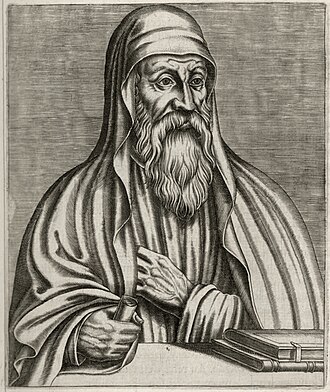 Origen
"When, therefore, as will be clear to those who read, the passage as a connected whole is literally impossible, whereas the outstanding part of it is not impossible but even true, the reader must endeavor to grasp the entire meaning, connecting by an intellectual process the account of what is literally impossible with the parts that are not impossible but historically true, these being interpreted allegorically in common with the part which, so far as the letter goes, did not happen at all. For our contention with regard to the whole of divine scripture is that it all has a spiritual meaning, but not all a bodily meaning; for the bodily meaning is often proved to be an impossibility."
Origen of Alexandria, also known as Origen Adamantius, was an early Christian scholar, ascetic, and theologian who was born and spent the first half of his career in Alexandria. He was a prolific writer who wrote roughly 2,000 treatises in multiple branches of theology, including textual criticism, biblical exegesis and hermeneutics, homiletics, and spirituality. He was one of the most influential
"On the other hand a man admits the energy and control and inspired to strive towards things heavenly and divine"
Origen"[W]ho that has understanding will suppose that the first, and second, and third day, and the evening and the morning, existed without a sun, and moon, and stars? and that the first day was, as it were, also without a sky? And who is so foolish as to suppose that God, after the manner of a husbandman, planted a paradise in Eden, towards the east, and placed in it a tree of life, visible and palpable, so that one tasting of the fruit by the bodily teeth obtained life? and again, that one was a partaker of good and evil by masticating what was taken from the tree? And if God is said to walk in the paradise in the evening, and Adam to hide himself under a tree, I do not suppose that anyone doubts that these things figuratively indicate certain mysteries, the history having taken place in appearance, and not literally. Cain also, when going forth from the presence of God, certainly appears to thoughtful men as likely to lead the reader to inquire what is the presence of God, and what is the meaning of going out from Him. ..."
Origen"It is our endeavor to show that the providence of God which governs the universe with justice also rules immortal souls on the most equitable principles in accordance with the merits and motives of each individual. For God’s dealings with men are not confined within the life of this age, but a previous state of merit always furnishes the cause of the state that is to follow; and so by an immortal and eternal law of equity and by the control of divine providence the immortal soul is brought to the height of perfection."
Origen"The soul of while in the body, can admit different energies, that is, controlling influences, of spirits either good or bad. Now the bad spirits work in two ways; that is, they either take whole and entire possession of the mind, so that they allow those in their power neither to understand nor to think, as is the case, for example, with those who are popularly called “possessed,” whom we see to be demented and insane, such as the men who are related in the Gospel to have been healed by the Savior; or they deprave the soul, while it still thinks and understands, through harmful suggestion by means of different kinds of thoughts and evil inducements"
Origen"In this way, then, by the renewal of the ceaseless working of Father, Son, and Holy Spirit in us, in its various stages of progress, shall we be able at some future time perhaps, although with difficulty, to behold the holy and the blessed life, in which (as it is only after many struggles that we are able to reach it) we ought so to continue, that no satiety of that blessedness should ever seize us; but the more we perceive its blessedness, the more should be increased and intensified within us the longing for the same, while we ever more eagerly and freely receive and hold fast the Father, and the Son, and the Holy Spirit. But if satiety should ever take hold of any one of those who stand on the highest and perfect summit of attainment, I do not think that such an one would suddenly be deposed from his position and fall away, but that he must decline gradually and little by little, so that it may sometimes happen that if a brief lapsus take place, and the individual quickly repent and return to himself, he may not utterly fall away, but may retrace his steps, and return to his former place, and again make good that which had been lost by his negligence."
Origen"As the eye naturally seeks the light and vision, and our body naturally desires food and drink, so our mind is possessed with a becoming and natural desire to become acquainted with the truth of God and the causes of things."
Origen