SHAWORDS
Origen

Origen

Origen

Origen

author
28Quotes

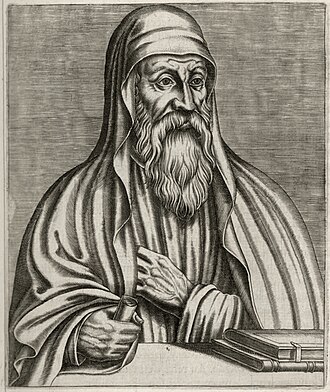
Origen of Alexandria, also known as Origen Adamantius, was an early Christian scholar, ascetic, and theologian who was born and spent the first half of his career in Alexandria. He was a prolific writer who wrote roughly 2,000 treatises in multiple branches of theology, including textual criticism, biblical exegesis and hermeneutics, homiletics, and spirituality. He was one of the most influential

Popular Quotes

28 total
Quote
"When Origen died he left behind a massive body of writings numbering close to a thousand titles.This vast treasure...was widely used for more than a century without serious obstacles to its diffusion...It had appeared even during Origens Alexandrian period, and it redoubled immediately after his death...His works spread rapidly in the West as well as in the East, emerged unscathed from every skirmish and went on spreading. But from about 375 on everything changed... There followed the physical destruction of his writings... Nearly all of Origens work perished....Luckily there was a number of Latin translations."
OrigenOrigen
Quote
"That is properly termed everlasting or eternal which neither had a beginning of existence, nor can ever cease to be what it is. And this is the idea conveyed by John when he says that God is light. Now His wisdom is the splendour of that light, not only in respect of its being light, but also of being everlasting light, so that His wisdom is eternal and everlasting splendour. If this be fully understood, it clearly shows that the existence of the Son is derived from the Father but not in time, nor from any other beginning, except, as we have said, from God Himself."
OrigenOrigen
Quote
"When, therefore, as will be clear to those who read, the passage as a connected whole is literally impossible, whereas the outstanding part of it is not impossible but even true, the reader must endeavor to grasp the entire meaning, connecting by an intellectual process the account of what is literally impossible with the parts that are not impossible but historically true, these being interpreted allegorically in common with the part which, so far as the letter goes, did not happen at all. For our contention with regard to the whole of divine scripture is that it all has a spiritual meaning, but not all a bodily meaning; for the bodily meaning is often proved to be an impossibility."
OrigenOrigen
Quote
"[W]ho that has understanding will sup­pose that the first, and second, and third day, and the evening and the morning, ex­isted without a sun, and moon, and stars? and that the first day was, as it were, also without a sky? And who is so foolish as to suppose that God, after the manner of a husbandman, planted a paradise in Eden, towards the east, and placed in it a tree of life, visible and palpable, so that one tasting of the fruit by the bodily teeth obtained life? and again, that one was a partaker of good and evil by masticating what was taken from the tree? And if God is said to walk in the paradise in the evening, and Adam to hide himself under a tree, I do not suppose that anyone doubts that these things figuratively indi­cate certain mysteries, the history having taken place in appearance, and not literally. Cain also, when going forth from the presence of God, certainly appears to thoughtful men as likely to lead the reader to inquire what is the presence of God, and what is the meaning of going out from Him. ..."
OrigenOrigen
Quote
"It is our endeavor to show that the providence of God which governs the universe with justice also rules immortal souls on the most equitable principles in accordance with the merits and motives of each individual. For God’s dealings with men are not confined within the life of this age, but a previous state of merit always furnishes the cause of the state that is to follow; and so by an immortal and eternal law of equity and by the control of divine providence the immortal soul is brought to the height of perfection."
OrigenOrigen
Quote
"All these, down to the very least, God supervises by the power of his wisdom and distinguishes by the controlling hand of his judgment; and thus he has arranged the universe on the principle of a most impartial retribution, according as each one deserves for his merit to be assisted or cared for. Herein is displayed in its completeness the principle of impartiality, when the inequality of circumstances preserves an equality of reward for merit. But the grounds of merit in each individual are known with truth and clearness only to God, together with his only-begotten Word and Wisdom and his Holy Spirit."
OrigenOrigen

Similar Authors & Thinkers