Quote
"Where possible, circumcision should not be done until the person is able to give informed consent."
 Circumcision
"While I continue to be troubled by new and creative manifestations of anti-Semitism, the truth is, I’m still not really sure how I feel about the bris. This entire series of events mostly makes me wonder about the centrality of masculinity in our cultures — Jewish and Western. It feels like this entire story is a kind of male turf war, a battle over whose penis is superior. It’s as if the uncircumcised penis is as much of a threat to Jewish identity as the circumcised penis is to Gentiles."
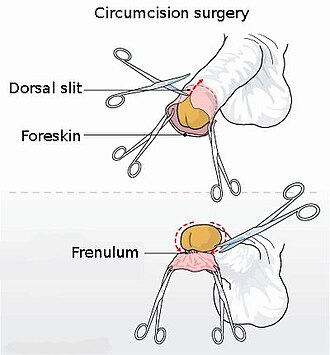
Circumcision is a surgical procedure that removes the foreskin from the human penis. In the procedure's most common form, the foreskin is extended with forceps, then a circumcision device may be placed, after which the foreskin is excised. Topical or locally injected anesthesia is generally used to reduce pain and physiologic stress. Circumcision is undertaken for religious, cultural, social, and
"Where possible, circumcision should not be done until the person is able to give informed consent."
Circumcision"A remedy [for masturbation] which is almost always successful in small boys is circumcision, especially when there is any degree of phimosis. The operation should be performed by a surgeon without administering an anæsthetic, as the brief pain attending the operation will have a salutary effect upon the mind, especially if it be connected with the idea of punishment, as it may well be in some cases. The soreness which continues for several weeks interrupts the practice, and if it had not previously become too firmly fixed, it may be forgotten and not resumed."
Circumcision"To cut off the uppermost skin of the secret parts is directly against the honesty of nature, and an injurious insufferable trick put upon her."
Circumcision"Bris has a way of erasing the lives of women from the moment we are born. The bris ceremony becomes a major celebration of a boy’s birth, leaving the arrival of a girl ritualistically unnoticed, except in certain Sephardic communities, where there is a centuries-old tradition of honoring the birth of a Jewish daughter. The past generation or two of women have sought to fill in that void, but it’s still an uphill battle. Some expectant grandparents, for example, still wait to make appropriate travel plans based on gender — for a boy, of course they will attend the bris, but for “just” a girl they might not rush to make the trip. In an adult course on the Jewish lifecycle I once taught, I had to use a curriculum with the following chapter titles: “Bris, Bar/ Bat mitzvah, Wedding, Death.” The educators seemed to lack any awareness that there’s more to a birth than the bris. This classic vision of the Jewish lifecycle, emphasizing the bris as the quintessential moment of birth, practically ignores the existence of girl babies and the experiences of women. This dismisses the entire experience of childbirth, as if to say we’re not really celebrating new life — we’re celebrating a new set of male genitals for the Chosen People. Howard Eilberg-Schwartz has written that “Since circumcision binds men between and across generations, it also establishes an opposition between men and women”"
Circumcision"In an apparent effort to bolster the weak anticircumcision argument, 2 anecdotal beliefs are added to the listed reasons not to choose circumcision: the "protective benefit" of the foreskin on the tip of the penis and the belief that circumcision causes decreased sexual pleasure later in life. Neither of these anecdotal beliefs meets the stated criterion of being evidence-based."
Circumcision"I think it should be enough to simply state: all genital mutilation is wrong. I don’t discriminate between which gender should suffer genital mutilation, and which shouldn’t – that very distinction, right there, is the precise definition of sexual discrimination."
Circumcision"Gentlemen, no fighting please. This is, after all, a council of war. (p. 26)"
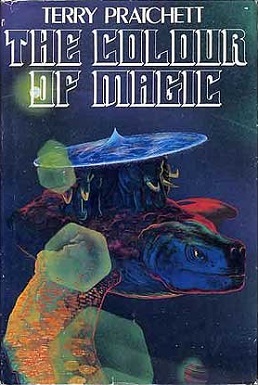 Discworld
"I should say that when people talk about capitalism its a bit of a joke. Theres no such thing. No country, no business class, has ever been willing to subject itself to the free market, free market discipline. Free markets are for others. Like, the Third World is the Third World because they had free markets rammed down their throat. Meanwhile, the enlightened states, England, the United States, others, resorted to massive state intervention to protect private power, and still do. Thats right up to the present. I mean, the Reagan administration for example was the most protectionist in post-war American history. Virtually the entire dynamic economy in the United States is based crucially on state initiative and intervention: computers, the internet, telecommunication, automation, pharmaceutical, you just name it. Run through it, and you find massive ripoffs of the public, meaning, a system in which under one guise or another the public pays the costs and takes the risks, and profit is privatized. Thats very remote from a free market. Free market is like what India had to suffer for a couple hundred years, and most of the rest of the Third World."
"The Dwarf sees farther than the Giant, when he has the Giants shoulders to mount on."
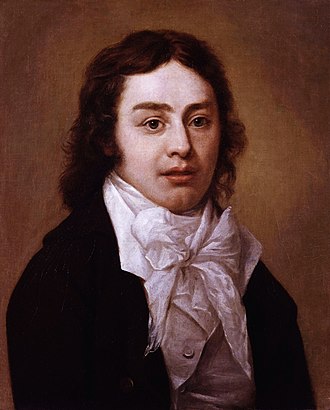 Samuel Taylor Coleridge
"If civilization has an opposite, it is war."
"A word of the faith that never balks, Here or henceforward it is all the same to me, I accept Time absolutely. It alone is without flaw, it alone rounds and completes all, That mystic baffling wonder alone completes all. (23)"
"I am dominated by one thing, an irresistible, burning attraction towards the abstract. The expression of human feelings and the passions of man certainly interest me deeply, but I am less concerned with expressing the motions of the soul and mind than to render visible, so to speak, the inner flashes of intuition which have something divine in their apparent insignificance and reveal magic, even divine horizons, when they are transposed into the marvellous effects of pure plastic art."
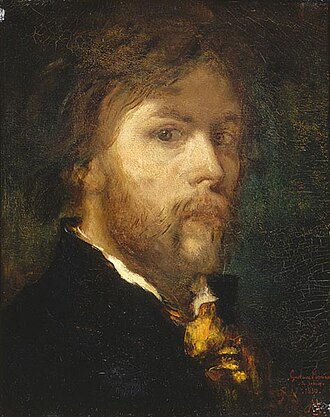 Gustave Moreau