Quote
"To do nothing is sometimes a good remedy."
H
Hippocrates"Whoever having undertaken to speak or write on Medicine, have first laid down for themselves some hypothesis to their argument, such as hot, or cold, or moist, or dry, or whatever else they choose, (thus reducing their subject within a narrow compass, and supposing only one or two original causes of diseases or of death among mankind,) are all clearly mistaken in much that they say; and this is the more reprehensible as relating to an art which all men avail themselves of on the most important occasions... For there are practitioners, some bad and some far otherwise, which, if there had been no such thing as Medicine, and if nothing had been investigated or found out in it... all would have been equally unskilled and ignorant of it, and everything concerning the sick would have been directed by chance. But now it is not so; for, as in all the other arts, those who practise them differ much from one another in dexterity and knowledge, so is it in like manner with Medicine. Wherefore I have not thought that it stood in need of an empty hypothesis, like those subjects which are occult and dubious... as, for example, with regard to things above us [meteorology, astronomy or astrology] and things below the earth [geology, Hades, , or outside of the ]; if any one should treat of these and undertake to declare how they are constituted, the reader or hearer could not find out, whether what is delivered be true or false; for there is nothing which can be referred to in order to discover the truth."
Hippocrates of Kos, also known as Hippocrates II, named after his grandfather Hippocrates I was a Greek physician and philosopher of the classical period who is considered one of the most outstanding figures in the history of medicine. He is traditionally referred to as the "Father of Medicine" in recognition of his lasting contributions to the field, such as the use of prognosis and clinical obse
"To do nothing is sometimes a good remedy."
"It is time which imparts strength to all things and brings them to maturity."
"Time is that wherein there is opportunity, and opportunity is that wherein there is no great time. Healing is a matter of time, but it is sometimes also a matter of opportunity. However, knowing this, one must attend to medical practice not primarily to plausible theories, but to experience combined with reason. For a theory is a composite memory of things apprehended with sense perception."
"Those things which are sacred, are to be imparted only to sacred persons; and it is not lawful to impart them to the profane until they have been initiated in the mysteries of the science."
"I will follow that system of regimen which, according to my ability and judgment, I consider for the benefit of my patients, and abstain from whatever is deleterious and mischievous. I will give no deadly medicine to any one if asked, nor suggest any such counsel; and in like manner I will not give to a woman a pessary to produce abortion."
"A natural talent is required; for, when Nature opposes, everything else is in vain; but when Nature leads the way to what is most excellent, instruction in the art takes place, which the student must try to appropriate to himself by reflection, becoming an early pupil in a place well adapted for instruction. He must also bring to the task a love of labor and perseverance, so that the instruction taking root may bring forth proper and abundant fruits."
"The wound is the place where the Light enters you."
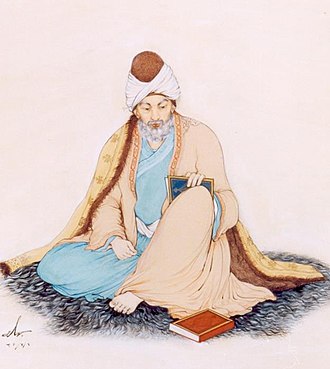 Rumi
Rumi"Be the change that you wish to see in the world."
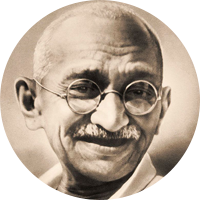 Mahatma Gandhi
"In philosophy equally as in poetry it is the highest and most useful prerogative of genius to produce the strongest impressions of novelty, while it rescues admitted truths from the neglect caused by the very circumstance of their universal admission."
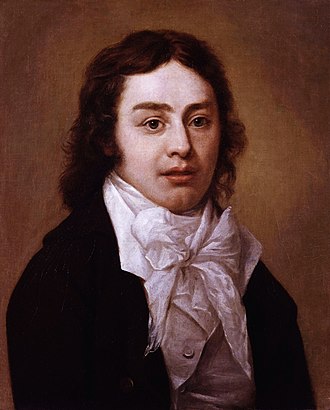 Samuel Taylor Coleridge
"An [hypertext] encyclopaedia will be an overall attempt by the knowledgeable, the learned societies or anyone else, to represent the state-of-the-art in their field. An encyclopaedia will be a living document, as up to date as it can be, instantly accessible at any time. It will contain carefully authored explanations and summaries of the subject, as well as computer-generated indexes of literature. A reference to a paper from the encyclopaedia conveys authority and acceptance by academic society. A measure of a paper’s standing may be conveyed by the number of links it is away from an encyclopaedia."
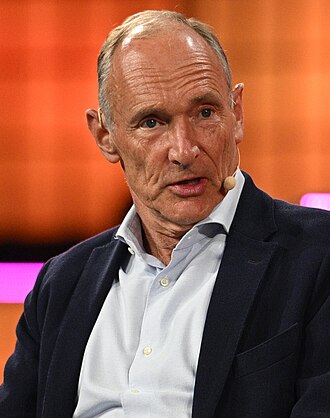 Tim Berners-Lee
"The British intellectual tradition is empirical and liberal, the French is rationalist and aristocratic, and the German is idealist and conservative. ...In the great ontological debate between mind and matter, German philosophy comes down solidly on the side of mind. Its emphasis is intuition as opposed to reason, ideas as opposed to facts."
"To know the mighty works of God, to comprehend His wisdom and majesty and power; to appreciate, in degree, the wonderful workings of His laws, surely all this must be a pleasing and acceptable mode of worship to the Most High, to whom ignorance cannot be more grateful than knowledge."