SHAWORDS

Would you not think him an utter fool who wept because he was not aliv — Seneca the Younger

"Would you not think him an utter fool who wept because he was not alive a thousand years ago? And is he not just as much of a fool who weeps because he will not be alive a thousand years from now? It is all the same; you will not be, and you were not. Neither of these periods of time belongs to you."
Seneca the Younger
Seneca the Younger
Seneca the Younger
author259 quotes

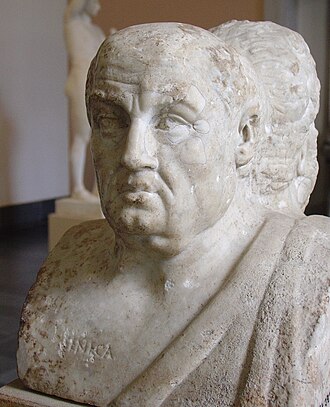
Lucius Annaeus Seneca the Younger, usually known mononymously as Seneca, was a Stoic philosopher of Ancient Rome, a statesman, a dramatist, and in one work, a satirist, from the post-Augustan age of Latin literature.

More by Seneca the Younger

View all →
Quote
"Nec multis verbis nec circumitu longo, quod sit summum bonum, colliges1; digito, ut ita dicam, demonstrandum est nec in multa spargendum. Quid enim ad rem pertinet in particulas illud diducere, cum possis dicere: summum bonum est, quod honestum est? Et quod magis admireris: unum bonum est, quod honestum est, cetera falsa et bona sunt. Hoc si persuaseris tibi et virtutem adamaveris, amare enim parum est, quicquid illa contigerit, id tibi, qualecumque aliis videbitur, faustum felixque erit. Et torqueri, si modo iacueris ipso torquente securior, et aegrotare, si non male dixeris fortunae, si non cesseris morbo, omnia denique, quae ceteris videntur mala, et mansuescent et in bonum abibunt, si super illa eminueris."
Seneca the YoungerSeneca the Younger

More on Time

View all →
Quote
"History is a strange experience. The world is quite small now; but history is large and deep. Sometimes you can go much farther by sitting in your own home and reading a book of history, than by getting onto a ship or an airplane and traveling a thousand miles. When you go to Mexico City through space, you find it a sort of cross between modern Madrid and modern Chicago, with additions of its own; but if you go to Mexico City through history, back only 500 years, you will find it as distant as though it were on another planet: inhabited by cultivated barbarians, sensitive and cruel, highly organized and still in the Copper Age, a collection of startling, of unbelievable contrasts."
G
Gilbert Highet
Quote
"As soon as a thought or word becomes a tool, one can dispense with actually ‘thinking’ it, that is, with going through the logical acts involved in verbal formulation of it. As has been pointed out, often and correctly, the advantage of mathematics—the model of all neo-positivistic thinking—lies in just this ‘intellectual economy.’ Complicated logical operations are carried out without actual performance of the intellectual acts upon which the mathematical and logical symbols are based. … Reason … becomes a fetish, a magic entity that is accepted rather than intellectually experienced."
M
Mathematics