Quote
"Only what we have wrought into our character during life can we take away with us."
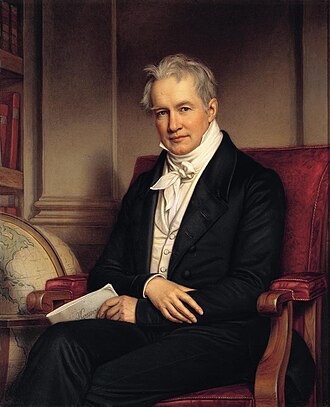 Alexander von Humboldt
Alexander von Humboldt
Alexander von Humboldt
Friedrich Wilhelm Heinrich Alexander von Humboldt was a German polymath, geographer, naturalist, explorer, and proponent of Romantic philosophy and science. He was the younger brother of the Prussian minister, philosopher, and linguist Wilhelm von Humboldt (1767–1835). Humboldt's quantitative work on botanical geography laid the foundation for the field of biogeography, while his advocacy of long-
"Only what we have wrought into our character during life can we take away with us."
Alexander von Humboldt"Our imagination is struck only by what is great; but the lover of natural philosophy should reflect equally on little things."
Alexander von Humboldt"Devoted from my earliest youth to the study of nature, feeling with enthusiasm the wild beauties of a country guarded by mountains and shaded by ancient forests, I experienced in my travels, enjoyments which have amply compensated for the privations inseparable from a laborious and often agitated life."
Alexander von Humboldt"The expression of vanity and self-love becomes less offensive, when it retains something of simplicity and frankness."
Alexander von Humboldt"That celebrated traveller Humboldt was profoundly impressed with the scientific value of a combined effort to be made by the observers of all nations, to obtain accurate measurements of the magnetism of the earth; and we owe it mainly to his enthusiasm for science... that not only private men of science, but the governments of most of the civilised nations... were induced to take part in the enterprise."
Alexander von Humboldt"While we maintain the unity of the human species, we at the same time repel the depressing assumption of superior and inferior races of men. There are nations more susceptible of cultivation, more highly civilized, more enobled by mental cultivation than others, but none in themselves nobler than others. All are in like degree designed for freedom; a freedom which, in the ruder conditions of society, belongs only to the individual, but which, in social states enjoying political institutions, appertains as a right to the whole body of the community."
Alexander von Humboldt