SHAWORDS
John Marshall

John Marshall

John Marshall

John Marshall

author
27Quotes

John Marshall was an American statesman, jurist, and Founding Father who served as the fourth chief justice of the United States from 1801 until his death in 1835. He remains the longest-serving chief justice and fifth-longest-serving justice in the history of the U.S. Supreme Court, and he is widely regarded as one of the most influential justices ever to serve. Prior to joining the court, Marsha

Popular Shayari

27 total
Quote
"The very essence of civil liberty certainly consists in the right of every individual to claim the protection of the laws whenever he receives an injury. One of the first duties of government is to afford that protection. In Great Britain, the King himself is sued in the respectful form of a petition, and he never fails to comply with the judgment of his court. In the third volume of his Commentaries, page 23, Blackstone states two cases in which a remedy is afforded by mere operation of law. "In all other cases," he says, "it is a general and indisputable rule that where there is a legal right, there is also a legal remedy by suit or action at law whenever that right is invaded." And afterwards, page 109 of the same volume, he says, "I am next to consider such injuries as are cognizable by the Courts of common law. And herein I shall for the present only remark that all possible injuries whatsoever that did not fall within the exclusive cognizance of either the ecclesiastical, military, or maritime tribunals are, for that very reason, within the cognizance of the common law courts of justice, for it is a settled and invariable principle in the laws of England that every right, when withheld, must have a remedy, and every injury its proper redress." The Government of the United States has been emphatically termed a government of laws, and not of men. It will certainly cease to deserve this high appellation if the laws furnish no remedy for the violation of a vested legal right."
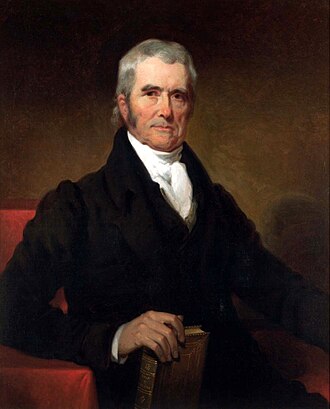
John MarshallJohn Marshall
Quote
"The power to create [a bank] implies the power to preserve [it]... That the power to tax involves the power to destroy; that the power to destroy may defeat and render useless the power to create; that there is a plain repugnance in conferring on one Government a power to control the constitutional measures of another, which other, with respect to those very measures, is declared to be supreme over that which exerts the control, are propositions not to be denied. But all inconsistencies are to be reconciled by the magic of the word CONFIDENCE. Taxation, it is said, does not necessarily and unavoidably destroy. To carry it to the excess of destruction would be an abuse, to presume which would banish that confidence which is essential to all Government. But is this a case of confidence? Would the people of any one State trust those of another with a power to control the most insignificant operations of their State Government? We know they would not. Why, then, should we suppose that the people of any one State should be willing to trust those of another with a power to control the operations of a Government to which they have confided their most important and most valuable interests? In the Legislature of the Union alone are all represented. The Legislature of the Union alone, therefore, can be trusted by the people with the power of controlling measures which concern all, in the confidence that it will not be abused. This, then, is not a case of confidence, and we must consider it is as it really is."
John MarshallJohn Marshall
Quote
"This great principle is that the Constitution and the laws made in pursuance thereof are supreme; that they control the Constitution and laws of the respective States, and cannot be controlled by them. From this, which may be almost termed an axiom, other propositions are deduced as corollaries, on the truth or error of which, and on their application to this case, the cause has been supposed to depend. These are, 1st. That a power to create implies a power to preserve; 2d. That a power to destroy, if wielded by a different hand, is hostile to, and incompatible with these powers to create and to preserve; 3d. That, where this repugnancy exists, that authority which is supreme must control, not yield to that over which it is supreme."
John MarshallJohn Marshall
Quote
"Courts are the mere instruments of the law, and can will nothing. When they are said to exercise a discretion, it is a mere legal discretion, a discretion to be exercised in discerning the course prescribed by law; and, when that is discerned, it is the duty of the Court to follow it. Judicial power is never exericised for the purpose of giving effect to the will of the Judge; always for the purpose of giving effect to the will of the Legislature; or, in other words, to the will of the law."
John MarshallJohn Marshall
Quote
"We admit, as all must admit, that the powers of the Government are limited, and that its limits are not to be transcended. But we think the sound construction of the Constitution must allow to the national legislature that discretion with respect to the means by which the powers it confers are to be carried into execution which will enable that body to perform the high duties assigned to it in the manner most beneficial to the people. Let the end be legitimate, let it be within the scope of the constitution, and all means which are appropriate, which are plainly adapted to that end, which are not prohibited, but consist with the letter and spirit of the constitution, are constitutional."
John MarshallJohn Marshall
Quote
"It is admitted that the power of taxing the people and their property is essential to the very existence of Government, and may be legitimately exercised on the objects to which it is applicable, to the utmost extent to which the Government may choose to carry it. The only security against the abuse of this power is found in the structure of the Government itself. In imposing a tax, the legislature acts upon its constituents. This is, in general, a sufficient security against erroneous and oppressive taxation. The people of a State, therefore, give to their Government a right of taxing themselves and their property, and as the exigencies of Government cannot be limited, they prescribe no limits to the exercise of this right, resting confidently on the interest of the legislator and on the influence of the constituent over their representative to guard them against its abuse."
John MarshallJohn Marshall
Quote
"It has been said, that the people had already surrendered all their powers to the State sovereignties, and had nothing more to give. But, surely, the question whether they may resume and modify the powers granted to government does not remain to be settled in this country. Much more might the legitimacy of the general government be doubted, had it been created by the States. The powers delegated to the State sovereignties were to be exercised by themselves, not by a distinct and independent sovereignty, created by themselves. To the formation of a league, such as was the confederation, the State sovereignties were certainly competent. But when, "in order to form a more perfect union," it was deemed necessary to change this alliance into an effective government, possessing great and sovereign powers, and acting directly on the people, the necessity of referring it to the people, and of deriving its powers directly from them, was felt and acknowledged by all."
John MarshallJohn Marshall
Quote
"The powers of the legislature are defined, and limited; and that those limits may not be mistaken, or forgotten, the constitution is written. To what purpose are powers limited, and to what purpose is that limitation committed to writing, if these limits may, at any time, be passed by those intended to be restrained? The distinction, between a government with limited and unlimited powers, is abolished, if those limits do not confine the persons on whom they are imposed, and if acts prohibited and acts allowed, are of equal obligation. It is a proposition too plain to be contested, that the constitution controls any legislative act repugnant to it; or, that the legislature may alter the constitution by an ordinary act."
John MarshallJohn Marshall
Quote
"The subject is the execution of those great powers on which the welfare of a Nation essentially depends. It must have been the intention of those who gave these powers, to insure, as far as human prudence could insure, their beneficial execution. This could not be done by confiding the choice of means to such narrow limits as not to leave it in the power of Congress to adopt any which might be appropriate, and which were conducive to the end. This provision is made in a constitution intended to endure for ages to come, and, consequently, to be adapted to the various crises of human affairs."
John MarshallJohn Marshall
Quote
"[T]he Government of the Union, though limited in its powers, is supreme within its sphere of action. This would seem to result necessarily from its nature. It is the Government of all; its powers are delegated by all; it represents all, and acts for all. Though any one State may be willing to control its operations, no State is willing to allow others to control them. The nation, on those subjects on which it can act, must necessarily bind its component parts. But this question is not left to mere reason; the people have, in express terms, decided it by saying, [p406] "this Constitution, and the laws of the United States, which shall be made in pursuance thereof," "shall be the supreme law of the land," and by requiring that the members of the State legislatures and the officers of the executive and judicial departments of the States shall take the oath of fidelity to it. The Government of the United States, then, though limited in its powers, is supreme, and its laws, when made in pursuance of the Constitution, form the supreme law of the land, "anything in the Constitution or laws of any State to the contrary notwithstanding."
John MarshallJohn Marshall
Quote
"[..] it can scarcely be necessary to say that the existence of State banks can have no possible influence on the question. No trace is to be found in the Constitution of an intention to create a dependence of the Government of the Union on those of the States, for the execution of the great powers assigned to it. Its means are adequate to its ends, and on those means alone was it expected to rely for the accomplishment of its ends. To impose on it the necessity of resorting to means which it cannot control, which another Government may furnish or withhold, would render its course precarious, the result of its measures uncertain, and create a dependence on other Governments which might disappoint its most important designs, and is incompatible with the language of the Constitution. But were it otherwise, the choice of means implies a right to choose a national bank in preference to State banks, and Congress alone can make the election. After the most deliberate consideration, it is the unanimous and decided opinion of this Court that the act to incorporate the Bank of the United States is a law made in pursuance of the Constitution, and is a part of the supreme law of the land."
John MarshallJohn Marshall
Quote
"Whether a law be void for its repugnancy to the Constitution, is, at all times, a question of much delicacy, which out seldom, if ever, to be decided in the affirmative, in doubtful case. … But it is not on slight implication and vague conjecture that the legislature is to be pronounced to have transcended its powers, and its acts to be considered as void. The opposition between the Constitution and the law should be such that the judge feels a clear and strong conviction of their incompatibility with each other."
John MarshallJohn Marshall

Similar Authors & Thinkers