Quote
"Giambattista della Porta, who seems to have been the first to try combinations of lenses to form a microscope, based his optical work almost entirely on that of Roger Bacon, Witelo, and Pecham."
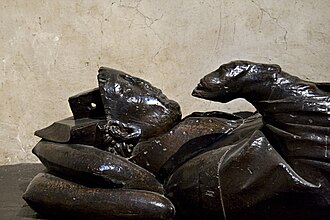 John Peckham
John Peckham
John Peckham
John Peckham was a Franciscan friar and Archbishop of Canterbury in the years 1279–1292.
"Giambattista della Porta, who seems to have been the first to try combinations of lenses to form a microscope, based his optical work almost entirely on that of Roger Bacon, Witelo, and Pecham."
John Peckham"Light from a concave luminous body is received most powerfully at the centre. The reason for this is that, for every point of a concave body, perpendicular rays, which are stronger than others, converge in the centre. Therefore the virtues of celestial bodies are incident most powerfully in and near the centre of the world."
John Peckham"The Perspectiva is a clear and concise summary of the science of light at the time... a popular text on optics until the seventeenth century... used and cited by many medieval and Renaissance scholars, including Leonardo da Vinci and Johannes Kepler."
John Peckham"Pechams Perspectiva was published in as many as nine editions, one in Italian, between 1482 and 1627."
John Peckham"In the realm of psychology (in the medieval sense), Pechams writings are extensive. ...each soul is created singly and "daily" by God. The soul... is everywhere in its little world as God is everywhere in the the bigger world. The soul is united to the body as a form is to matter. ...The human will is free and cannot be coerced by anything else. ...The will is free to the extent that it can withhold consent to the dictates of practical reason."
John Peckham"Following Ibn-Haytham [ and his Book of Optics with regard to the Moon illusioin ] Pecham supports the intervening objects theory. However, the interposition of vapours is also thought to produce enlargement by refraction. This work probably predates Pechams Perspectiva communis (1275)."
John Peckham"Another Oxford writer who appreciated experimental science was John Pecham... In his Perspectiva Communis Pecham gave a very clear and concise summary of contemporary optics, based largely on Alhazen, Witelo, and pseudo-Euclids De Speculis. His book contained nothing original but it remained a popular text book until the seventeenth century."
John Peckham"The marked superiority of Ibn al-Haythams treatise did not necessarily cause interested readers, even those of intelligence, to reject the Optics out of hand. On the contrary, it was precisely among the most avid disciples of Ibn al-Haytham in the West—the so-called Perspectivists, whose members included Roger Bacon, Witelo, and John Pecham—that Ptolemys Optics found the most eager audience."
John Peckham"In 1278 he was appointed Archbishop of Canterbury by Nicholas III., in spite of the attempts made by Edward I. to gain the preferment for his chancellor, Robert Burnell, Bishop of Bath and Wells; but was not consecrated till the spring of the following year. He was well received by the king and showed himself a strong prelate, a determined foe of pluralists, and quite ready to champion the cause of ecclesiastical reform against the king himself, when need arose."
John Peckham"[Perspectiva communis was written to] compress into concise summaries the teachings of perspective, which [in existing treatises] are presented with great obscurity."
John Peckham"There were many natural philosophers, particularly in the West, who looked to al-Kindi for support in their defense of a combined intromission-extramission theory. Grosseteste, an early defender of such a combined theory, was in all likelihood familiar with al-Kindis De aspectibus and probably had al-Kindi in mind when he wrote: "However, mathematicians and physicists, whose concerns is with those things that are above nature, ...maintain that vision is produced by extramission." Later in the thirteenth century Roger Bacon and John Pecham also appealed to the authority of al-Kindi to support their contention that rays issue from, as well as enter, the observers eye."
John Peckham"The difference between Pechams Tractatus de perspectiva and his Perspectiva communis is striking. The former has significant religious content and was apparently intended as a devotional aid. The latter deals exclusively with optics, and reveals neither biblical nor theological influence."
John Peckham




