Quote
"As you know I have always been more afraid of a peace offer than of an air raid."
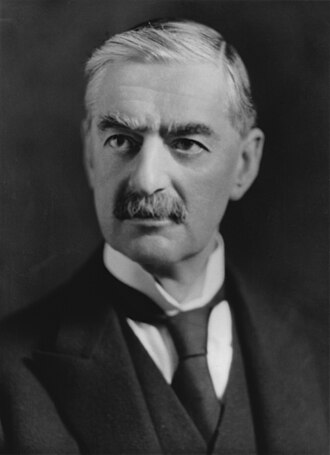 Neville Chamberlain
Neville Chamberlain
Neville Chamberlain
Arthur Neville Chamberlain was a British politician who served as Prime Minister of the United Kingdom from May 1937 to May 1940 and Leader of the Conservative Party from May 1937 to October 1940. He is best known for his foreign policy of appeasement, and in particular for his signing of the Munich Agreement on 30 September 1938, ceding the German-speaking Sudetenland region of Czechoslovakia to
"As you know I have always been more afraid of a peace offer than of an air raid."
Neville Chamberlain"My good friends, this is the second time in our history that there has come back from Germany to Downing Street peace with honour. I believe it is peace for our time."
Neville Chamberlain"It fell to Neville Chamberlain in one of the supreme crises of the world to be contradicted by events, to be disappointed in his hopes, and to be deceived and cheated by a wicked man. But what were these hopes in which he was disappointed? What were these wishes in which he was frustrated? What was that faith that was abused? They were surely among the most noble and benevolent instincts of the human heart-the love of peace, the toil for peace, the strife for peace, the pursuit of peace, even at great peril, and certainly to the utter disdain of popularity or clamour."
Neville Chamberlain"This morning I had another talk with the German Chancellor, Herr Hitler, and here is the paper which bears his name upon it as well as mine.... We regard the agreement signed last night and the Anglo-German Naval Agreement, as symbolic of the desire of our two peoples never to go to war with one another again."
Neville Chamberlain"You have sat here too long for any good you are doing. Depart, I say, and let us have done with you. In the name of God, go!"
Neville Chamberlain"This morning the British Ambassador in Berlin handed the German Government a final note, stating that, unless we heard from them by 11 oclock that they were prepared at once to withdraw their troops from Poland, a state of war would exist between us. I have to tell you now that no such undertaking has been received and that consequently this country is at war with Germany. … It is evil things that we will be fighting against—brute force, bad faith, injustice, oppression and persecution—and against them I am certain that the right will prevail."
Neville Chamberlain"The result was that when war did break out German preparations were far ahead of our own, and it was natural then to expect that the enemy would take advantage of his initial superiority to make an endeavour to overwhelm us and France before we had time to make good our deficiencies. Is it not a very extraordinary thing that no such attempt was made? Whatever may be the reason—whether it was that Hitler thought he might get away with what he had got without fighting for it, or whether it was that after all the preparations were not sufficiently complete—however, one thing is certain: he missed the bus."
Neville Chamberlain"I often think to myself that its not I but someone else who is P.M. and is the recipient of those continuous marks of respect and affection from the general public who called in Downing Street or at the station to take off their hats and cheer. And then I go back to the House of Commons and listen to the unending stream of abuse of the P.M., his faithlessness, his weakness, his wickedness, his innate sympathy with Fascism and his obstinate hatred of the working classes."
Neville Chamberlain"We were convinced that a major war was in the offing, what with the uncorrelated news before us of Schuschniggs arrest by the Nazis, the fall of the French cabinet, Blums formation of a new one, the mobilization of French troops on the border and the clamor of the British population for the resignation of Neville Chamberlain, who continued to place the interests of his class above the interests of his country."
Neville Chamberlain"Neville Chamberlain, on the other hand, was alert, businesslike, opinionated, and self-confident in a very high degree. Unlike Baldwin, he conceived himsef to be able to comprehend the whole field of Europe, and indeed the world. Instead of a vague but none the less deep-seated intuition, we had now a narrow, sharp-edged efficiency within the limits of the policy in which he believed. Both as Chancellor of the Exchequer and as Prime Minister, he kept the tightest and most rigid control upon military expenditure. He was throughout this period the masterful opponent of all emergency measures. He had formed decided judgments about all the political figures of the day, both at home and abroad, and felt himself capable of dealing with them. His all-pervading hope was to go down to history as the Great Peacemaker; and for this he was prepared to strive continually in the teeth of facts, and face great risks for himself and his country. Unhappily, he ran into tides the force of which he could not measure, and met hurricanes from which he did not flinch, but with which he could not cope. In these closing years before the war, I should have found it easier to work with Baldwin, as I knew him, than with Chamberlain; but neither of them had any wish to work with me except in the last resort."
Neville Chamberlain"That, too, was what Neville Chamberlain was clearly doing in London from 1937 until the gray morning of 1941 when his cancer finally killed him. During those fateful years he too was "sparring with the situation," seeking an easy way out. He has been accused round the world of being a foolish old man who did not understand what it would take to defend his country against the Nazis. That, I am sure, is a fundamental error. He knew full well the number of planes and tanks it would take, but he could not bring himself to the hard decision of ordering the industrial and economic revolution that was necessary to produce them."
Neville Chamberlain"If ever that silly old man comes interfering here again with his umbrella, Ill kick him downstairs and jump on his stomach in front of the photographers."
Neville Chamberlain




