Quote
"Loonies speak their own language, like educated people."
P
Patrick WhitePatrick White
author ·
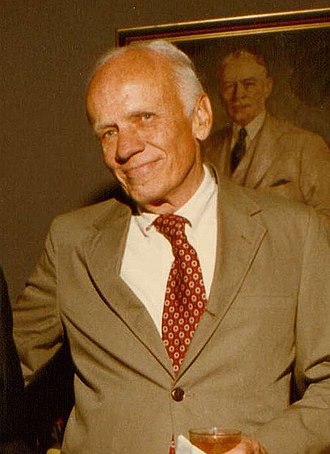
Patrick Victor Martindale White was an Australian novelist and playwright who explored themes of religious experience, personal identity and the conflict between visionary individuals and a materialistic, conformist society. Influenced by the modernism of James Joyce, D. H. Lawrence and Virginia Woolf, he developed a complex literary style and a body of work that challenged the dominant realist pr
"Loonies speak their own language, like educated people."
"Conversation is imperative if gaps are to be filled, and old age, it is the last gap but one."
"In my books I have lifted bits from various religions in trying to come to a better understanding; Ive made use of religious themes and symbols. Now, as the world becomes more pagan, one has to lead people in the same direction in a different way."
"The essence of what you have to say you pick up before youre twenty."
"Ive lost interest in the theatre because you cant get what you want ever. I used to think it would be wonderful to see what you had written come to life. Here in Australia its very hard to get an adequate performance because of the state of the theatre; but even if you have the best actors in the world its never what you visualised. One cant say all one wants to say, one cant convey it."
"I always like to write three versions of a book. The first is always agony and chaos; no one could understand it. With the second you get the shape, its more or less all right. I write both of those in longhand. The third draft I type out with two fingers: its for refining of meaning, additions and subtractions. I think my novels usually begin with characters; you have them floating about in your head and it may be years before they get together in a situation. Characters interest me more than situations."
"In the last couple of years Ive been doing this sort of thing constantly, often repeating myself, becoming an avoidable Doomsday bore. But anything of importance — like a garden, a human relationship, a child, a religious faith, even the most convinced brand of atheism has to be worked on constantly if it is to survive."
"In recent years we have been served up a lot of claptrap about the need for a national identity. We have been urged to sing imbecile jingles, flex our muscles like the sportsmen from telly commercials, and display a heart optimism totally unconvincing because so superficial an unnatural. Those who preach this doctrine are usually the kind of chauvinist who is preparing his country, not to avert war, but to engage in it."
"The ideal of non-attachment has been preached again and again in the course of the last 3000 years. It is found in Hinduism, the teachings of Buddha, the doctrine of Lao Tsu, in the philosophy of the Greek Stoics. The Gospel of Jesus is essentially one of non-attachment to the things of this world, and of attachment to God. What the Jewish philosopher Spinoza calls "blessedness" is simply the state of non-attachment, just as Spinozas "human bondage" is the condition of one who identifies himself with his own desires, emotions, and thought processes, or with their objects in the external world."
"In the 14th Century an anonymous English mystic wrote a book called The Cloud of Unknowing, the main theme of which is that God cannot be apprehended by mans intellect and that only love can pierce the "cloud of unknowing" which lies between Him and us. I feel that in my own life anything I have done of possible worth has happened in spite of my gross, worldly self. I have been no more than the vessel used to convey ideas above my intellectual capacities. When people praise passages I have written, more often than not I can genuinely say, Did I write that? I dont think this is due to my having a bad memory, because I have almost total recall of trivialities. I see it as evidence of the part the supernatural plays in lives which would otherwise remain earthbound."
"Many of those who hear me believe I am putting on an act, while others who had considered I am one who surely knows the answers, are depressed to find that, by my own admission, I dont. What I do know for certain is that what is regarded as success in a rational materialistic society only impresses superficial minds. It amounts to nothing and will not help us rout the destructive forces threatening us today. What may be our salvation is the discovery of the identity hidden deep in any one of us, and which may be found in even the most desperate individual, if he cares to search the spiritual womb which contains the embryo of what can be ones personal contribution to truth and life."
"Why cant a writer use writing as a painter uses paint? I try to. When I wrote The Tree of Man I felt I couldnt write about simple, illiterate people in a perfectly literate way; but in my present novel the language is more sophisticated. I think perhaps I have clarified my style quite a lot over the years. I find it a great help to hear the language going on around me; not that what I write, the narrative, is idiomatic Australian, but the whole work has a balance and rhythm which is influenced by what is going on around you. When you first write the narrative it might be unconscious, but when you come to work it over you do it more consciously. It gives what I am writing a greater feeling of reality."