Quote
"Throughout, we shall be exemplifying the thesis of D. M. MacKay: that quantity of information, as measured here, always corresponds to some quantity, i.e. intensity, of selection, either actual or imaginable"
W
W. Ross AshbyW. Ross Ashby
W. Ross Ashby
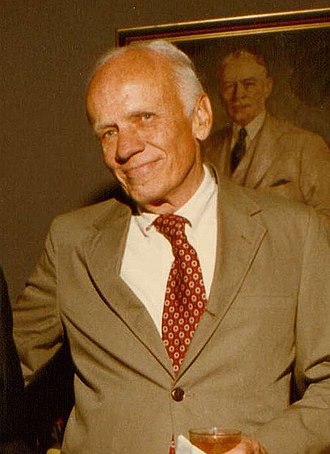
William Ross Ashby was an English psychiatrist and a pioneer in cybernetics, the study of the science of communications and automatic control systems in both machines and living things. His first name was not used: he was known as Ross Ashby.
"Throughout, we shall be exemplifying the thesis of D. M. MacKay: that quantity of information, as measured here, always corresponds to some quantity, i.e. intensity, of selection, either actual or imaginable"
"The primary fact is that all isolated state-determined dynamic systems are selective: from whatever state they have initially, they go towards states of equilibrium. These states of equilibrium are always characterised, in their relation to the change-inducing laws of the system, by being exceptionally resistant."
"As shorthand, when the phenomena are suitably simple, words such as equilibrium and stability are of great value and convenience. Nevertheless, it should be always borne in mind that they are mere shorthand, and that the phenomena will not always have the simplicity that these words presuppose."
"Cybernetics treats not things but ways of behaving. It does not ask “what is this thing?” but “what does it do?”... It is thus essentially functional and behaviouristic. Cybernetics deals with all forms of behavior in so far as they are regular, or determinate, or reproducible. The materiality is irrelevant... The truths of cybernetics are not conditional on their being derived from some other branch of science. Cybernetics has its own foundations."
"The most fundamental concept in cybernetics is that of "difference", either that two things are recognisably different or that one thing has changed with time. Its range of application need not be described now, for the subsequent chapters will illustrate the range abundantly. All the changes that may occur with time are naturally included, for when plants grow and planets age and machines move some change from one state to another is implicit. So our first task will be to develop this concept of "change", not only making it more precise but making it richer, converting it to a form that experience has shown to be necessary if significant developments are to be made."
"[T]he concept of “”, so simple and natural in certain elementary cases, becomes artificial and of little use when the interconnexions between the parts become more complex. When there are only two parts joined so that each affects the other, the properties of the feedback give important and useful information about the properties of the whole. But when the parts rise to even as few as four, if every one affects the other three, then twenty circuits can be traced through them; and knowing the properties of all the twenty circuits does not give complete information about the system. Such complex systems cannot be treated as an interlaced set of more or less independent feedback circuits, but only as a whole. For understanding the general principles of dynamic systems, therefore, the concept of feedback is inadequate in itself. What is important is that complex systems, richly cross-connected internally, have complex behaviours, and that these behaviours can be goal-seeking in complex patterns."
"Many workers in the biological sciences — physiologists, psychologists, sociologists — are interested in cybernetics and would like to apply its methods and techniques to their own specialty. Many have, however, been prevented from taking up the subject by an impression that its use must be preceded by a long study of electronics and advanced pure mathematics; for they have formed the impression that cybernetics and these subjects are inseparable. The author is convinced, however, that this impression is false. The basic ideas of cybernetics can be treated without reference to electronics, and they are fundamentally simple; so although advanced techniques may be necessary for advanced applications, a great deal can be done, especially in the biological sciences, by the use of quite simple techniques, provided they are used with a clear and deep understanding of the principles involved. It is the author’s belief that if the subject is founded in the common-place and well understood, and is then built up carefully, step by step, there is no reason why the worker with only elementary mathematical knowledge should not achieve a complete understanding of its basic principles. With such an understanding he will then be able to see exactly what further techniques he will have to learn if he is to proceed further; and, what is particularly useful, he will be able to see what techniques he can safely ignore as being irrelevant to his purpose."
"During the last few years it has become apparent that the concept of "machine" must be very greatly extended if it is to include the most modern developments. Especially is this true if we are studying the brain and attempting to identify the type of mechanism that is responsible for the brain’s outstanding powers of thought and action. It has become apparent that when we used to doubt whether the brain could be a machine, our doubts were due chiefly to the fact that by ‘‘machine’’ we understood some mechanism of very simple type. Familiar with the bicycle and the typewriter, we were in great danger of taking them as the type of all machines. The last decade, however, has corrected this error. It has taught us how restricted our outlook used to be; for it developed mechanisms that far transcended the utmost that had been thought possible, and taught us that ‘‘mechanism’’ was still far from exhausted in its possibilities. Today we know only that the possibilities extend beyond our farthest vision."
"[Constraint] is a relation between two sets, and occurs when the variety that exists under one condition is less than the variety that exists under another."
"The most basic facts in biology are that this earth is now two thousand million years old, and that the biologist studies mostly that which exists today."
"The invasion of psychology by cybernetics is making us realize that the ordinary concepts of psychology must be reformulated in the language of physics if a physical explanation of the ordinary psychological phenomena is to become possible. Some psychological concepts can be re-formulated more or less easily, but others are much more difficult, and the investigator must have a deep insight if the physical reality behind the psychological phenomena is to be perceived"
"Cybernetics was defined by Wiener as “the science of control and communication, in the animal and the machine” — in a word, as the art of steermanship, and it is to this aspect that the book will be addressed. Co-ordination, regulation and control will be its themes, for these are of the greatest biological and practical interest. We must, therefore, make a study of mechanism; but some introduction is advisable, for cybernetics treats the subject from a new, and therefore unusual, angle... The new point of view should be clearly understood, for any unconscious vacillation between the old and the new is apt to lead to confusion."