Quote
"Coretti didnt know how to dress. Clothing was a language and Coretti a kind of sartorial stutterer, unable to make the kind of basic coherent fashion statement that would put strangers at their ease."
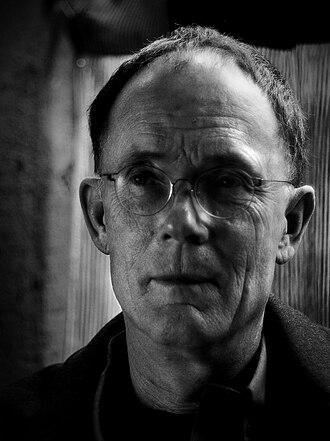 William Gibson
William Gibson
William Gibson
William Ford Gibson is an American and Canadian speculative fiction writer and essayist widely credited with pioneering the science fiction subgenre known as cyberpunk, a category from which he has repeatedly distanced himself. Beginning his writing career in the late 1970s, his early works were noir, near-future stories that explored the effects of technology, cybernetics, and computer networks o
"Coretti didnt know how to dress. Clothing was a language and Coretti a kind of sartorial stutterer, unable to make the kind of basic coherent fashion statement that would put strangers at their ease."
William Gibson"Bets were being made, being covered. The kickers were producing the hard stuff, the old stuff, liberty-headed dollars and Roosevelt dimes from the stamp-and-coin stores, while more cautious bettors slapped down antique paper dollars laminated in clear plastic. Through the haze came a trio of red planes, flying in formation. Fokker D.VIIs. The room fell silent."
William Gibson"I think of religions as franchise operations. Like chicken franchise operations. But that doesnt mean theres no chicken, right?"
William Gibson"I became so frustrated with my inability to physically move the characters through the imaginary narrative space, that I actually developed an early form of imaginary VR technology that sort of covered my ass ... all they had to do was switch tapes and be in a different place, and I was spared the embarrassment of demonstrating that I didnt know how to get them up and down the stairs."
William Gibson"Seated each afternoon in the darkened screening room, Halliday came to recognize the targeted numerals of the Academy leader as sigils preceding the dream state of a film."
William Gibson"Macao," the Finn said. "Macao?" "The Long Hum family. Stockbrokers." The Long Hum people were so oblique that they made my idea of a subtle approach look like a tactical nuke-out."
William Gibson"This newfound state of No Future is, in my opinion, a very good thing. It indicates a kind of maturity, an understanding that every future is someone elses past, every present someone elses future. Upon arriving in the capital-F Future, we discover it, invariably, to be the lower-case now. The best science fiction has always known that, but it was a sort of cultural secret. When I began to write fiction, at the very end of the Seventies, I was fortunate to have been taught, as an undergraduate, that imaginary futures are always, regardless of what the authors might think, about the day in which theyre written. Orwell knew it, writing Nineteen Eighty-Four in 1948, and I knew it writing Neuromancer, my first novel, which was published in 1984."
William Gibson"In the age of wooden television in the South where I grew up, leisure involved sitting on screened porches, smoking cigarettes, drinking iced tea, engaging in conversation, and staring into space. It might also involve fishing. Sometimes the Web does remind me of fishing."
William Gibson"“Surfing the Web” (as dubious a metaphor as “the information highway”) is, as a friend of mine has it, “like reading magazines with the pages stuck together.” My wife shakes her head in dismay as I patiently await the downloading of some Japanese Beatles fans personal catalog of bootlegs. “But it’s from Japan!” She isnt moved. She goes out to enjoy the flowers in her garden."
William Gibson"Loss is not without its curious advantages for the artist. Major traumatic breaks are pretty common in the biographies of artists I respect."
William Gibson"The future is already here — its just not very evenly distributed."
William Gibson"The NET is a waste of time, and thats exactly whats right about it."
William Gibson




