Quote
"...there is nothing more corrupting, nothing more destructive of the noblest and finest feelings of our nature, than the exercise of unlimited power."
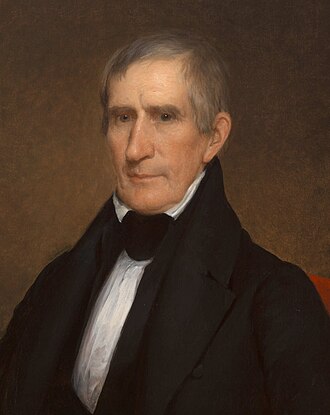 William Henry Harrison
William Henry Harrison
William Henry Harrison
William Henry Harrison was the ninth president of the United States from March to April 1841. He died 31 days into his term, making him the shortest serving president and the first president to die in office. Immediately after his death, vice president John Tyler took over, ending the constitutional crisis that had been triggered by the question of presidential succession in the U.S. Constitution.
"...there is nothing more corrupting, nothing more destructive of the noblest and finest feelings of our nature, than the exercise of unlimited power."
William Henry Harrison"The strongest of all governments is that which is most free."
William Henry Harrison"…it is preposterous to suppose that a thought could for a moment have been entertained that the President, placed at the capital, in the center of the country, could better understand the wants and wishes of the people than their own immediate representatives, who spend a part of every year among them, living with them, often laboring with them, and bound to them by the triple tie of interest, duty, and affection."
William Henry Harrison"The only legitimate right to govern is an express grant of power from the governed."
William Henry Harrison"It may be observed, however, that organized associations of citizens requiring compliance with their wishes too much resemble the recommendations of Athens to her allies, supported by an armed and powerful fleet."
William Henry Harrison"It is necessary, therefore, to watch, not the political opponents of the administration, but the administration itself, and to see that it keeps within the bounds of the Constitution and the laws of the land. The executive of the Union has immense power to do mischief if he sees fit to exercise that power. He may prostrate the country. Indeed this country has been already prostrated. It has already fallen from pure republicanism to a monarchy in spirit if not in name."
William Henry Harrison"I have determined never to remove a Secretary of the Treasury without communicating all the circumstances attending such removal to both Houses of Congress."
William Henry Harrison"There is no part of the means placed in the hands of the Executive which might be used with greater effect for unhallowed purposes than the control of the public press."
William Henry Harrison"Fellow-citizens, being fully invested with that high office to which the partiality of my countrymen has called me, I now take an affectionate leave of you. You will bear with you to your homes the remembrance of the pledge I have this day given to discharge all the high duties of my exalted station according to the best of my ability, and I shall enter upon their performance with entire confidence in the support of a just and generous people."
William Henry Harrison"Yelping at the scent of a wounded fox, the Whigs threw everything into the campaign of 1840. It is still remembered as one of the great campaigns, and yet "great" seems too majestic a word for what was basically the cynical triumph of advertising over substance. After nominating the elderly military hero William Henry Harrison, the Whigs fell into paroxysms of excitement over the rumor that their candidate lived in a log cabin and had a fondness for hard cider. In fact, neither claim was true. Harrison was born into a considerably more substantial dwelling, an old brick mansion on the James River in Virginia. But that did not matter in the least. When in doubt, print the legend- and the image of an impoverished boy running around a log cabin entered the popular folklore, well before Lincoln ever figured out that modesty was a path to power. The great irony, of course, is that the log-cabin-and-hard-cider slogan was much truer of van Burens life than his opponents, and that he was being outsmarted by a ruthless opposition that had mastered all of his techniques. But no one was interested in the truth in 1840- only in the result."
William Henry Harrison"William Henry Harrisons death marked the first time in American history that presidential power abruptly transferred from one man to another. It is a testament to the American system that without precedent or clarity in the Constitution, power transferred so seamlessly and swiftly through a seminal historic moment of ambiguity. This particular transfer of power was made all the more remarkable by the extraordinary set of circumstances that led to the annexation of Texas in 1844 and precipitated war with Mexico. The war, which was fought by Tylers successor, James K. Polk, failed to win popular support from a population that supported admission of Texas, but preferred not to fight."
William Henry Harrison




