Quote
"We cannot observe external things without some degree of Thought; nor can we reflect upon our Thoughts, without being influenced in the course of our reflection by the Things which we have observed."
W
William WhewellWilliam Whewell
William Whewell
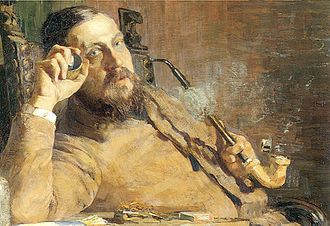
William Whewell was an English polymath. He was Master of Trinity College, Cambridge. In his time as a student there, he achieved distinction in both poetry and mathematics.
"We cannot observe external things without some degree of Thought; nor can we reflect upon our Thoughts, without being influenced in the course of our reflection by the Things which we have observed."
"The Sight cannot decompose a compound colour into simple colours, or distinguish a compound from a simple colour"
"A Natural System is one which attempts to make all the divisions natural, the widest as well as the narrowest; and therefore applies no characters peremptorily."
"In Deductive Reasoning, we cannot have any truth in the conclusion which is not virtually contained in the premises."
"The solution is, that we do not see the image on the retina at all, we only see by means of it."
"We unfold out of the Idea of Space the propositions of geometry, which are plainly truths of the most rigorous necessity and universality. But if the idea of space were merely collected from observation of the external world, it could never enable or entitle us to assert such propositions: it could never authorize us to say that not merely some lines, but all lines, not only have, but must have, those properties which geometry teaches. Geometry in every proposition speaks a language which experience never dares to utter; and indeed of which she but half comprehends the meaning."
"Among the foundations of the Higher Mathematics is also the Idea of a Limit. The Idea of a Limit cannot be superseded by any other definitions or Hypotheses."
"The Idea of Cause is expressed for purposes of science by these three Axioms:—Every Event must have a Cause:—Causes are measured by their Effects:—Reaction is equal and opposite to Action."
"Mechanical, chemical, and vital Forces form an ascending progression, each including the preceding. Chemical Affinity includes in its nature Mechanical Force, and may often be practically resolved into Mechanical Force. (Thus the ingredients of gunpowder, liberated from their chemical union, exert great mechanical Force : a galvanic battery acting by chemical process does the like.) Vital Forces include in their nature both chemical Affinities and mechanical Forces: for Vital Powers produce both chemical changes, (digestion,) and motions which imply considerable mechanical force, (as the motion of the sap and of the blood.)"
"Facts are the materials of science, but all Facts involve Ideas. Since, in observing Facts, we cannot exclude Ideas, we must, for the purposes of science, take care that the Ideas are clear and rigorously applied."
"In the Ancient Period of Science, Technical Terms were formed in three different ways:—by appropriating common words and fixing their meaning;—by constructing terms containing a description;—by constructing terms containing reference to a theory."
"In order to acquire any exact and solid knowledge, the student must possess with perfect precision the ideas appropriate to that part of knowledge: and this precision is tested by the students perceiving the axiomatic evidence of the axioms belonging to each Fundamental Idea."