SHAWORDS
Yasunari Kawabata

Yasunari Kawabata

Yasunari Kawabata

Yasunari Kawabata

author
21Quotes

Yasunari/Kōsei Kawabata was a Japanese novelist and short story writer whose spare, lyrical, subtly-shaded prose works won him the 1968 Nobel Prize in Literature, the first Japanese author to receive the award. His works have enjoyed broad international appeal and are still widely read.

Popular Quotes

21 total
Quote
"Dr. Yashiro Yukio, internationally known as a scholar of Botticelli, a man of great learning in the art of the past and the present, of the East and the West, has summed up one of the special characteristics of Japanese art in a single poetic sentence: "The time of the snows, of the moon, of the blossoms — then more than ever we think of our comrades." When we see the beauty of the snow, when we see the beauty of the full moon, when we see the beauty of the cherries in bloom, when in short we brush against and are awakened by the beauty of the four seasons, it is then that we think most of those close to us, and want them to share the pleasure. The excitement of beauty calls forth strong fellow feelings, yearnings for companionship, and the word "comrade" can be taken to mean "human being". The snow, the moon, the blossoms, words expressive of the seasons as they move one into another, include in the Japanese tradition the beauty of mountains and rivers and grasses and trees, of all the myriad manifestations of nature, of human feelings as well."
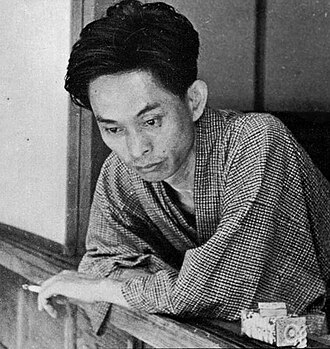
Yasunari KawabataYasunari Kawabata
Quote
"Ikenobo Seno remarked on another occasion (this too is in his Sayings) that "the mountains and strands should appear in their own forms". Bringing a new spirit into his school of flower arranging, therefore, he found "flowers" in broken vessels and withered branches, and in them too the enlightenment that comes from flowers. "The ancients arranged flowers and pursued enlightenment." Here we see awakening to the heart of the Japanese spirit, under the influence of Zen. And in it too, perhaps, is the heart of a man living in the devastation of long civil wars."
Yasunari KawabataYasunari Kawabata
Quote
"In the depths of the mirror the evening landscape moved by, the mirror and the reflected figures like motion pictures superimposed one on the other. The figures and the background were unrelated, and yet the figures, transparent and intangible, and the background, dim in the gathering darkness, melted into a sort of symbolic world not of this world. Particularly when a light out in the mountains shone in the center of the girls face, Shimamura felt his chest rise at the inexpressible beauty of it."
Yasunari KawabataYasunari Kawabata
Quote
"I myself have two specimens of Ikkyus calligraphy. One of them is a single line: "It is easy to enter the world of the Buddha, it is hard to enter the world of the devil." Much drawn to these words, I frequently make use of them when asked for a specimen of my own calligraphy. They can be read in any number of ways, as difficult as one chooses, but in that world of the devil added to the world of the Buddha, Ikkyu of Zen comes home to me with great immediacy. The fact that for an artist, seeking truth, good, and beauty, the fear and petition even as a prayer in those words about the world of the devil — the fact that it should be there apparent on the surface, hidden behind, perhaps speaks with the inevitability of fate. There can be no world of the Buddha without the world of the devil. And the world of the devil is the world difficult of entry. It is not for the weak of heart."
Yasunari KawabataYasunari Kawabata
Quote
"Ryokan, who shook off the modern vulgarity of his day, who was immersed in the elegance of earlier centuries, and whose poetry and calligraphy are much admired in Japan today — he lived in the spirit of these poems, a wanderer down country paths, a grass hut for shelter, rags for clothes, farmers to talk to. The profundity of religion and literature was not, for him, in the abstruse. He rather pursued literature and belief in the benign spirit summarized in the Buddhist phrase "a smiling face and gentle words". In his last poem he offered nothing as a legacy. He but hoped that after his death nature would remain beautiful. That could be his bequest."
Yasunari KawabataYasunari Kawabata
Quote
"Myōe exchanged poems with Saigyo and the two discussed poetry together. The following is from the biography of Myoe by his disciple Kikai: "Saigyo frequently came and talked of poetry. His own attitude towards poetry, he said, was far from the ordinary. Cherry blossoms, the cuckoo, the moon, snow: confronted with all the manifold forms of nature, his eyes and his ears were filled with emptiness. And were not all the words that came forth true words? When he sang of the blossoms the blossoms were not on his mind, when he sang of the moon he did not think of the moon. As the occasion presented itself, as the urge arose, he wrote poetry. The red rainbow across the sky was as the sky taking on color. The white sunlight was as the sky growing bright. Yet the empty sky, by its nature, was not something to become bright. It was not something to take on color. With a spirit like the empty sky he gives color to all the manifold scenes but not a trace remained. In such poetry was the Buddha, the manifestation of the ultimate truth." Here we have the emptiness, the nothingness, of the Orient. My own works have been described as works of emptiness, but it is not to be taken for the nihilism of the West. The spiritual foundation would seem to be quite different. Dogen entitled his poem about the seasons, "Innate Reality", and even as he sang of the beauty of the seasons he was deeply immersed in Zen."
Yasunari KawabataYasunari Kawabata

Similar Authors & Thinkers



