SHAWORDS

Above all, do not give up your moral and political autonomy by accepti — C. Wright Mills

"Above all, do not give up your moral and political autonomy by accepting in somebody elses terms the illiberal practicality of the bureaucratic ethos or the liberal practicality of the moral scatter. Know that many personal troubles cannot be solved merely as troubles, but must be understood in terms of public issues — and in terms of the problems of history making."
C. Wright Mills
C. Wright Mills
C. Wright Mills
author35 quotes

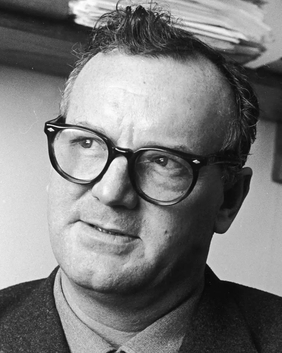
Charles Wright Mills was an American sociologist, and a professor of sociology at Columbia University from 1946 until his death in 1962. Mills published widely in both popular and intellectual journals, and is remembered for several books, such as The Power Elite, White Collar: The American Middle Classes, and The Sociological Imagination. Mills was concerned with the responsibilities of intellect

More by C. Wright Mills

View all →
Quote
"In a public, as we may understand the term, (1) virtually as many people express opinions as receive them, (2) Public communications are so organised that there is a chance immediately and effectively to answer back any opinion expressed in public. Opinion formed by such discussion (3) readily finds an outlet in effective action, even against – if necessary – the prevailing system of authority. And (4) authoritative institutions do not penetrate the public, which is thus more or less autonomous in its operations.-In a mass, (1) far fewer people express opinions than receive them; for the community of publics becomes an abstract collection of individuals who receive impressions from the mass media. (2) The communications that prevail are so organised that it is difficult or impossible for the individual to answer back immediately or with any effect. (3) The realisation of opinion in action is controlled by authorities who organise and control the channels of such action. (4) The mass has no autonomy from institutions; on the contrary, agents of authorised institutions penetrate this mass, reducing any autonomy it may have in the formation of opinion by discussion."
C. Wright MillsC. Wright Mills
Quote
"Those in authority within institutions and social structures attempt to justify their rule by linking it, as if it were a necessary consequence, with moral symbols, sacred emblems, or legal formulae which are widely believed and deeply internalized. These central conceptions may refer to a god or gods, the votes of the majority, the will of the people, the aristocracy of talents or wealth, to the divine right of kings or to the alleged extraordinary endowment of the person of the ruler himself."
C. Wright MillsC. Wright Mills
Quote
"America - a conservative country without any conservative ideology - appears now before the world a naked and arbitrary power, as, in the name of realism, its men of decision enforce their often crackpot definitions upon world reality. The second-rate mind is in command of the ponderously spoken platitude. In the liberal rhetoric, vagueness, and in the conservative mood, irrationality, are raised to principle. Public relations and the official secret, the trivializing campaign and the terrible fact clumsily accomplished, are replacing the reasoned debate of political ideas in the privately incorporated economy, the military ascendancy, and the political vacuum of modern America."
C. Wright MillsC. Wright Mills

More on Time

View all →
Quote
"History is a strange experience. The world is quite small now; but history is large and deep. Sometimes you can go much farther by sitting in your own home and reading a book of history, than by getting onto a ship or an airplane and traveling a thousand miles. When you go to Mexico City through space, you find it a sort of cross between modern Madrid and modern Chicago, with additions of its own; but if you go to Mexico City through history, back only 500 years, you will find it as distant as though it were on another planet: inhabited by cultivated barbarians, sensitive and cruel, highly organized and still in the Copper Age, a collection of startling, of unbelievable contrasts."
G
Gilbert Highet
Quote
"As soon as a thought or word becomes a tool, one can dispense with actually ‘thinking’ it, that is, with going through the logical acts involved in verbal formulation of it. As has been pointed out, often and correctly, the advantage of mathematics—the model of all neo-positivistic thinking—lies in just this ‘intellectual economy.’ Complicated logical operations are carried out without actual performance of the intellectual acts upon which the mathematical and logical symbols are based. … Reason … becomes a fetish, a magic entity that is accepted rather than intellectually experienced."
M
Mathematics