SHAWORDS

Aristotle especially, both by speculation and observation... reached s — Aristotle

HomeAristotleQuote
"Aristotle especially, both by speculation and observation... reached something like the modern idea of a succession of higher organizations from lower, and made the fruitful suggestion of "a perfecting principle" in Nature. With the coming in of Christian theology this tendency toward a yet truer theory of evolution was mainly stopped, but the old crude view remained..."
Aristotle
Aristotle
Aristotle
author157 quotes

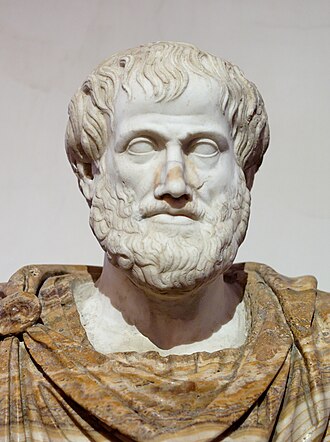
Aristotle was an ancient Greek philosopher and polymath. His writings span the natural sciences, philosophy, linguistics, economics, politics, psychology, and the arts. As the founder of the Peripatetic school of philosophy in the Lyceum in Athens, he began the wider Aristotelian tradition that followed, which set the groundwork for the development of modern science.

More by Aristotle

View all →
Quote
"I do believe for certain, that he [Aristotle] first procured, by the help of the senses, such experiments and observations as he could, to assure him as much as was possible of the conclusion, and that he afterwards sought out the means how to demonstrate it; for this is the usual course in demonstrative sciences. And the reason thereof is, because when the conclusion is true, by the help of the resolutive method, one may hit upon some proposition before demonstrated, or come to some principle known per se; but if the conclusion be false, a man may proceed in infinitum, and never meet with any truth already known."
AristotleAristotle
Quote
"[I]ts gravity is the cause; and that which is heavy abides in the middle, and the earth is in the middle: in like manner also, the infinite will abide in itself, through some other cause... and will itself support itself. ...[T]he places of the whole and the part are of the same species; as of the whole earth and a clod, the place is downward; and of the whole of fire, and a spark, the place is upward. So that if the place of the infinite is in itself, there will be the same place also of a part of the infinite."
AristotleAristotle
Quote
"According to one mode... nature is thus denominated, viz. the first subject matter to every thing which contains in itself the principle of motion and mutation. But after another mode it is denominated form, which subsists according to definition: for as art is called that which subsists according to art, and that which is artificial; so likewise nature is both called that which is according to nature, and that which is natural. ...that which is composed from these is not nature, but consists from nature; as, for instance, man. And this is nature in a greater degree than matter: for every thing is then said to be, when it is form in energy... entelecheia, rather than when it is incapacity."
AristotleAristotle
Quote
"[T]he ancient philosophers... all of them assert that the elements, and those things which are called by them principles, are contraries, though they establish them without reason, as if they were compelled to assert this by truth itself. They differ, however... that some of them assume prior, and others posterior principles; and some of them things more known according to reason, but others such as are more known according to sense: for some establish the hot and the cold, others the moist and the dry, others the odd and the even, and others strife and friendship, as the causes of generation. ...in a certain respect they assert the same things, and speak differently from each other. They assert different things... but the same things, so far as they speak analogously. For they assume principles from the same co-ordination; since, of contraries, some contain, and others are contained."
AristotleAristotle

More on Success

View all →
Quote
"One of the first major steps in the direction of modern skepticism came through the victory of Occam over Aquinas in a controversy about language. The statement that modi essendi were replaced by modi significandi et intelligendi, or that ontological referents were abandoned in favor of pragmatic significations, describes broadly the change in philosophy which continues to our time. From Occam to Bacon, from Bacon to Hobbes, and from Hobbes to contemporary semanticists, the progression is clear: ideas become psychological figments, words become useful signs. ... To one completely committed to this realm of becoming, as are the empiricists, the claim to apprehend verities is a sign of . Probably we have here but a highly sophisticated expression of the doctrine that ideals are hallucination and that the only normal, sane person is the healthy extrovert, making instant, instinctive adjustments to the stimuli of the material world."
O
Ontology
Quote
"I, too, believed it was impossible to change the existing society into one that would be for the benefit of all; neither could I espouse any given ideal for society. But [...] I felt that even if one did not have an ideal vision of society, one could have one’s work to do. Whether it was successful or not was not our concern; it was enough that we believed it to be a valid work. The accomplishment of that work, I believed, was what our real life was about. Yes. I want to carry out a work of my own; for I feel that by so doing our lives are rooted in the here and now, not in some far-off ideal goal."
P
Purpose
Quote
"The war was finished. It had lasted ten equivalent years and taken ten million lives. Thus it was neither of long duration nor of serious attrition. It hadnt any great significance; it was not intended to have. It did not prove a point, since all points had long ago been proven. What it did, perhaps, was to emphasize an aspect, sharpen a concept, underline a trend. On the whole it was a successful operation. Economically and ecologically it was of healthy effect, and who should grumble? And after wars, men go home. No, no, men start for home. Its not the same."
R
R. A. Lafferty