SHAWORDS

As one Tatler critic recognised when praising Henry Scott Tuke as par — Nudity

HomeNudityQuote
"As one Tatler critic recognised when praising Henry Scott Tuke as par excellence the painter of youth, the depiction of naked youths bathing or sitting on Cornish beaches looking contemplatively out to sea played an important part in Tukes artistic success. However, these paintings elicted a range of different readings and conflicting interpretations from Tukes viewers, some of which detected a sexualized approach on the artists part to the unclothed adolescent male body, while many others did not."
Nudity
Nudity
Nudity
author27 quotes

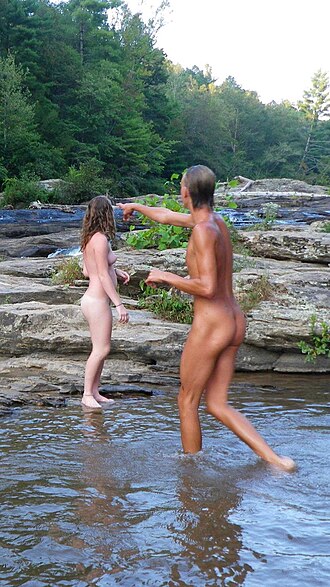
Nudity is the state of being in which a human is without clothing. While estimates vary, for the first 90,000 years of pre-history, anatomically modern humans were naked, having lost their body hair, living in hospitable climates, and not having developed the crafts needed to make clothing.

More by Nudity

View all →
Quote
"It was so much fun. Everyone was freaked out because I’m nude, but in real life, when I have sex, I’m naked. I don’t have a bra on, and I don’t usually have panties on. So let’s make a real movie! Let’s bring truth to the scene! I didn’t want to be exploited, but this girl—like most girls when they first have sex—doesn’t know what she’s doing. I wanted their first kiss to be sloppy, teenagerish making out. When you’re younger, you think you know what to do, but you really don’t."
NudityNudity

More on Success

View all →
Quote
"One of the first major steps in the direction of modern skepticism came through the victory of Occam over Aquinas in a controversy about language. The statement that modi essendi were replaced by modi significandi et intelligendi, or that ontological referents were abandoned in favor of pragmatic significations, describes broadly the change in philosophy which continues to our time. From Occam to Bacon, from Bacon to Hobbes, and from Hobbes to contemporary semanticists, the progression is clear: ideas become psychological figments, words become useful signs. ... To one completely committed to this realm of becoming, as are the empiricists, the claim to apprehend verities is a sign of . Probably we have here but a highly sophisticated expression of the doctrine that ideals are hallucination and that the only normal, sane person is the healthy extrovert, making instant, instinctive adjustments to the stimuli of the material world."
O
Ontology
Quote
"I, too, believed it was impossible to change the existing society into one that would be for the benefit of all; neither could I espouse any given ideal for society. But [...] I felt that even if one did not have an ideal vision of society, one could have one’s work to do. Whether it was successful or not was not our concern; it was enough that we believed it to be a valid work. The accomplishment of that work, I believed, was what our real life was about. Yes. I want to carry out a work of my own; for I feel that by so doing our lives are rooted in the here and now, not in some far-off ideal goal."
P
Purpose
Quote
"The war was finished. It had lasted ten equivalent years and taken ten million lives. Thus it was neither of long duration nor of serious attrition. It hadnt any great significance; it was not intended to have. It did not prove a point, since all points had long ago been proven. What it did, perhaps, was to emphasize an aspect, sharpen a concept, underline a trend. On the whole it was a successful operation. Economically and ecologically it was of healthy effect, and who should grumble? And after wars, men go home. No, no, men start for home. Its not the same."
R
R. A. Lafferty