SHAWORDS

“Explain it,” Hamilton muttered. “This place—this bar. Why doesn’t God — Philip K. Dick

"“Explain it,” Hamilton muttered. “This place—this bar. Why doesn’t God erase it? If this world operates by moral laws—” “This bar is necessary to the moral order. This is a sinkpit of corruption and vice, a fleshpot of iniquity. You think salvation can function without damnation? You think virtue can exist without sin? That’s the trouble with you atheists; you don’t grasp the mechanics of evil. Get on the inside and enjoy life, man. If you’re one of the Faithful, you’ve got nothing to worry about.” “Opportunist.” “Bet your sweet soul.”"
P
Philip K. Dick
Philip K. Dick
author220 quotes

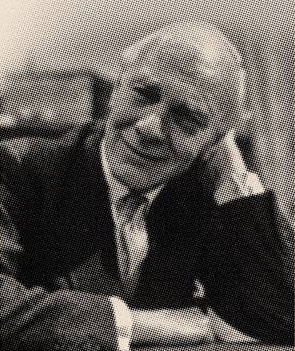
Philip Kindred Dick was an American science fiction short story writer and novelist. He wrote 45 novels and about 121 short stories, most of which appeared in science fiction magazines. His fiction explored varied philosophical and social questions such as the nature of reality, perception, human nature, and identity, and commonly featured characters struggling against alternate realities, illusor

More by Philip K. Dick

View all →
Quote
"Forty-two. His age had astounded him for years, and each time that he had sat so astounded, trying to figure out what had become of the young, slim man in his twenties, a whole additional year slipped by and had to be recorded, a continually growing sum which he could not reconcile with his self-image. He still saw himself, in his minds eye, as youthful, and when he caught sight of himself in photographs he usually collapsed ... Somebody took my actual physical presence away and substituted this, he had thought from time to time. Oh well, so it went."
P
Philip K. Dick
Quote
"Because today we live in a society in which spurious realities are manufactured by the media, by governments, by big corporations, by religious groups, political groups...So I ask, in my writing, What is real? Because unceasingly we are bombarded with pseudo-realities manufactured by very sophisticated people using very sophisticated electronic mechanisms. I do not distrust their motives; I distrust their power. They have a lot of it. And it is an astonishing power: that of creating whole universes, universes of the mind. I ought to know. I do the same thing."
P
Philip K. Dick
Quote
"What about [my] books? How do I feel about them? I enjoyed writing all of them. But I think that if I could only choose a few, which, for example, might escape World War Three, I would choose, first, Eye in the Sky. Then The Man in the High Castle. Martian Time-Slip (published by Ballantine). Dr. Bloodmoney (a recent Ace novel). Then The Zap Gun and The Penultimate Truth, both of which I wrote at the same time. And finally another Ace book, The Simulacra. But this list leaves out the most vital of them all: The Three Stigmata of Palmer Eldritch. I am afraid of that book; it deals with absolute evil, and I wrote it during a great crisis in my religious beliefs. I decided to write a novel dealing with absolute evil as personified in the form of a "human." When the galleys came from Doubleday I couldnt correct them because I could not bear to read the text, and this is still true. Two other books should perhaps be on this list, both very new Doubleday novels: Do Androids Dream of Electric Sheep? and another as yet untitled [Ubik]. Do Androids has sold very well and has been eyed intently by a film company who has in fact purchased an option on it. My wife thinks its a good book. I like it for one thing: It deals with a society in which animals are adored and rare, and a man who owns a real sheep is Somebody. . . and feels for that sheep a vast bond of love and empathy. Willis, my tomcat, strides silently over the pages of that book, being important as he is, with his long golden twitching tail. Make them understand, he says to me, that animals are really that important right now. He says this, and then eats up all the food we had been warming for our baby. Some cats are far too pushy. The next thing hell want to do is write SF novels. I hope he does. None of them will sell."
P
Philip K. Dick

More on Life

View all →
Quote
"If it fulfills our hopes, this center will be, at once, a symbol and a reflection and a hope. It will symbolize our belief that the world of creation and thought are at the core of all civilization. Only recently in the White House we helped commemorate the 400th anniversary of Shakespeare. The political conflicts and ambitions of his England are known to the scholar and to the specialist. But his plays will forever move men in every corner of the world. The leaders that he wrote about live far more vividly in his words than in the almost forgotten facts of their own rule. Our civilization, too, will largely survive in the works of our creation. There is a quality in art which speaks across the gulf dividing man from man and nation from nation, and century from century. That quality confirms the faith that our common hopes may be more enduring than our conflicting hostilities. Even now men of affairs are struggling to catch up with the insights of great art. The stakes may well be the survival of civilization. The personal preferences of men in government are not important--except to themselves. However, it is important to know that the opportunity we give to the arts is a measure of the quality of our civilization. It is important to be aware that artistic activity can enrich the life of our people, which really is the central object of Government. It is important that our material prosperity liberate and not confine the creative spirit."
L
Lyndon B. Johnson
Quote
"I did not go to join Kurtz there and then. I did not. I remained to dream the nightmare out to the end, and to show my loyalty to Kurtz once more. Destiny. My destiny! Droll thing life is — that mysterious arrangement of merciless logic for a futile purpose. The most you can hope from it is some knowledge of yourself — that comes too late — a crop of unextinguishable regrets. I have wrestled with death. It is the most unexciting contest you can imagine. It takes place in an impalpable grayness, with nothing underfoot, with nothing around, without spectators, without clamor, without glory, without the great desire of victory, without the great fear of defeat, in a sickly atmosphere of tepid skepticism, without much belief in your own right, and still less in that of your adversary. If such is the form of ultimate wisdom, then life is a greater riddle than some of us think it to be. I was within a hairs-breadth of the last opportunity for pronouncement, and I found with humiliation that probably I would have nothing to say. This is the reason why I affirm that Kurtz was a remarkable man. He had something to say. He said it. Since I had peeped over the edge myself, I understand better the meaning of his stare, that could not see the flame of the candle, but was wide enough to embrace the whole universe, piercing enough to penetrate all the hearts that beat in the darkness. He had summed up — he had judged. The horror! He was a remarkable man. After all, this was the expression of some sort of belief; it had candor, it had conviction, it had a vibrating note of revolt in its whisper, it had the appalling face of a glimpsed truth — the strange commingling of desire and hate."
H
Heart of Darkness