Quote
"This maayaa, that is to say, the ego, is like a cloud The sun cannot be seen on account of a thin patch of cloud; when that disappears one sees the sun If by the grace of the guru ones ego vanishes, then one sees God"
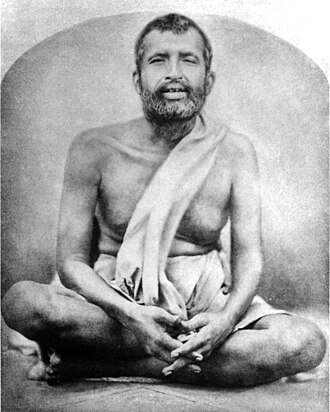 Ramakrishna
"God is directly perceived by the mind, but not by this ordinary mind It is the pure mind that perceives God, and at that time this ordinary mind does not function A mind that has the slightest trace of attachment to the world cannot be called pure When all the impurities of the mind are removed, you may call that mind Pure Mind or Pure Aatman"
Ramakrishna, also called Ramakrishna Paramahamsa, born Ramakrishna Chattopadhyay, was an Indian Hindu mystic. He was a devotee of the goddess Kali, but adhered to various religious practices from the Hindu traditions of Vaishnavism, Tantric Shaktism, and Advaita Vedanta, as well as Christianity and Sufi Islam. His parable-based teachings advocated the essential unity of religions and proclaimed th
"This maayaa, that is to say, the ego, is like a cloud The sun cannot be seen on account of a thin patch of cloud; when that disappears one sees the sun If by the grace of the guru ones ego vanishes, then one sees God"
Ramakrishna"Man cannot really help the world. God alone does that — He who has created the sun and the moon, who has put love for their children in parents hearts, endowed noble souls with compassion, and holy men and devotees with divine love. The man who works for others, without any selfish motive, really does good to himself. There is gold buried in your heart, but you are not yet aware of it. It is covered with a thin layer of earth. Once you are aware of it, all these activities of yours will lessen. … Through selfless work, love of God grows in the heart. Then, through His grace, one realizes Him in course of time. God can be seen, one can talk to Him, as I am talking to you."
Ramakrishna"Many are the names of God, and infinite the forms that lead us to know Him. In whatsoever name or form you desire to call Him, in that very form and name you will see Him."
Ramakrishna"Knowledge leads to unity, but Ignorance to diversity. So long as God seems to be outside and far away, there is ignorance. But when God is realised within, that is true knowledge."
Ramakrishna"God laughs on two occasions. He laughs when the physician says to the patients mother, "Dont be afraid, mother; I shall certainly cure your boy." God laughs, saying to Himself, "I am going to take his life, and this man says he will save it!" The physician thinks he is the master, forgetting that God is the Master. God laughs again when two brothers divide their land with a string, saying to each other, "This side is mine and that side is yours." He laughs and says to Himself, "The whole universe belongs to Me, but they say they own this portion or that portion."
Ramakrishna"He who is called Brahman by the jnanis is known as Atman by the yogis and as Bhagavan by the bhaktas. The same brahmin is called priest, when worshipping in the temple, and cook, when preparing a meal in the kitchen. The jnani, following the path of knowledge, always reason about the Reality saying, "not this, not this." Brahman is neither "this" nor "that"; It is neither the universe nor its living beings. Reasoning in this way, the mind becomes steady. Finally it disappears and the aspirant goes into samadhi. This is the Knowledge of Brahman. It is the unwavering conviction of the jnani that Brahman alone is real and the world is illusory. All these names and forms are illusory, like a dream. What Brahman is cannot be described. One cannot even say that Brahman is a Person. This is the opinion of the jnanis, the followers of Vedanta. But the bhaktas accept all the states of consciousness. They take the waking state to be real also. They dont think the world to be illusory, like a dream. They say that the universe is a manifestation of the Gods power and glory. God has created all these — sky, stars, moon, sun, mountains, ocean, men, animals. They constitute His glory."
Ramakrishna"As long as you keep getting born, it’s okay to die sometimes."
"The smart way to keep people passive and obedient is to strictly limit the spectrum of acceptable opinion, but allow very lively debate within that spectrum - even encourage the more critical and dissident views. That gives people the sense that theres free thinking going on, while all the time the presuppositions of the system are being reinforced by the limits put on the range of the debate."
"History is a strange experience. The world is quite small now; but history is large and deep. Sometimes you can go much farther by sitting in your own home and reading a book of history, than by getting onto a ship or an airplane and traveling a thousand miles. When you go to Mexico City through space, you find it a sort of cross between modern Madrid and modern Chicago, with additions of its own; but if you go to Mexico City through history, back only 500 years, you will find it as distant as though it were on another planet: inhabited by cultivated barbarians, sensitive and cruel, highly organized and still in the Copper Age, a collection of startling, of unbelievable contrasts."
"As soon as a thought or word becomes a tool, one can dispense with actually ‘thinking’ it, that is, with going through the logical acts involved in verbal formulation of it. As has been pointed out, often and correctly, the advantage of mathematics—the model of all neo-positivistic thinking—lies in just this ‘intellectual economy.’ Complicated logical operations are carried out without actual performance of the intellectual acts upon which the mathematical and logical symbols are based. … Reason … becomes a fetish, a magic entity that is accepted rather than intellectually experienced."
"Our feminist culture at the present moment is completely dependent on capitalism. My grandmother was still scrubbing clothes on the back porch on a washboard!"
"A word of the faith that never balks, Here or henceforward it is all the same to me, I accept Time absolutely. It alone is without flaw, it alone rounds and completes all, That mystic baffling wonder alone completes all. (23)"