Quote
"It is completely irrelevant that I am making them. Today is their creator."
R
Robert Rauschenberg"I dont feel any direct relationship between what I do and existing art. Though there is unavoidable progression: the things all paintings have in common are paint, and color, and some means of application. With the standard you can make any two pictures appear either alike of different. I dont think whether theyre alike or different is really very interesting."
Milton Ernest "Robert" or "Bob" Rauschenberg was an American painter and multi-media artist, whose work has been associated with numerous mid-20th century art movements including the New York School, Conceptual Art, Pop art, and Neo-Dada. Rauschenberg is well known for his Combines (1954–1964), a group of artworks which incorporated everyday objects as art materials and which blurred the distincti
"It is completely irrelevant that I am making them. Today is their creator."
"Josef Alberss [a former art teacher of Rauschenberg, on Black Mountain College ] rule is to make order. As for me, I consider myself successful when I do something that resembles the lack of order I sense. (around 1949 during Black Mountain College, fh)."
"Its almost as if art, in painting and music and stuff, is the leftover of some activity. The activity is the thing that Im most interested in. Nearly everything that Ive done was to see what would happen if I did this instead of that."
"Albers [on Black Mountain College ] was a beautiful teacher and an impossible person. He wasnt easy to talk to, and I found his criticism so excruciating and so devastating that I never asked for it. Years later, though, Im still learning what he taught me, because what he taught me had to do with the entire visual world. He didnt teach you how to do art. The focus was always on your personal sense of looking.. .I consider Albers the most important teacher Ive ever had, and Im sure that he considers me one of his poorest students."
"I think a picture is more like the real world when it is made out of the real world."
"I like the aliveness of it [theater] – that awful feeling of being on the spot. I must assume the responsibility for that moment, for those actions that happen at that particular time. I dont find theater that different from painting, and its not that I think of painting as theater or vice versa. I tend to think of working as a kind of involvement with materials, as well as rather focused interest which changes."
"I also know that the shock of Annabels death consolidated the frustration of that nightmare summer, made of it a permanent obstacle to any further romance throughout the cold years of my youth. The spiritual and the physical had been blended in us with a perfection that must remain incomprehensible to the matter-of-fact, crude, standard-brained youngsters of today. Long after her death I felt her thoughts floating through mine. Long before we met we had had the same dreams. We compared notes. We found strange affinities. The same June of the same year (1919) a stray canary had fluttered into her house and mine, in two widely separated countries. Oh, Lolita, had you loved me thus!"
 Lolita
"If you have always believed that everyone should play by the same rules and be judged by the same standards, that would have gotten you labeled a radical 50 years ago, a liberal 25 years ago and a racist today."
"Since the Chernobyl accident, we have worked all over the globe to raise nuclear safety performance. And since the September 2001 terrorist attacks, we have worked with even greater intensity on nuclear security. On both fronts, we have built an international network of legal norms and performance standards. But our most tangible impact has been on the ground. Hundreds of missions, in every part of the world, with international experts making sure nuclear activities are safe and secure. I am very proud of the 2,300 hard working men and women that make up the IAEA staff — the colleagues with whom I share this honour. Some of them are here with me today. We come from over 90 countries. We bring many different perspectives to our work. Our diversity is our strength. We are limited in our authority. We have a very modest budget. And we have no armies. But armed with the strength of our convictions, we will continue to speak truth to power. And we will continue to carry out our mandate with independence and objectivity."
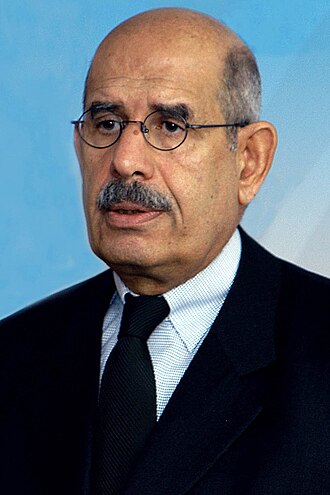 Mohamed ElBaradei
"Their standard, planted on the battlement, Despair and death among the soldiers sent."
"I compared some passages of articles of Robert McNamara in the late 1960s, speeches, on management and the necessity of management, how a well-managed society controlled from above was the ultimate in freedom. The reason is if you have really good management and everythings under control and people are told what to do, under those conditions, he said, man can maximize his potential. I just compared that with standard Leninist views on vanguard parties, which are about the same. About the only difference is that McNamara brought God in, and I suppose Lenin didnt bring God in. He brought Marx in."
"The centerpiece of the cultural counterrevolution is the snowballing campaign for a "drug-free workplace" — a euphemism for "drug-free workforce," since urine testing also picks up for off-duty indulgence. The purpose of this 80s version of the loyalty oath is less to deter drug use than to make people undergo a humiliating ritual of subordination: "When I say pee, you pee." The idea is to reinforce the principle that one must forfeit ones dignity and privacy to earn a living, and bring back the good old days when employers had the unquestioned right to demand that their workers appearance and behavior, on or off the job, meet managements standards."