Quote
"Do not imagine that it is less an accident by which you find yourself master of the wealth which you possess, than that by which this man found himself king."
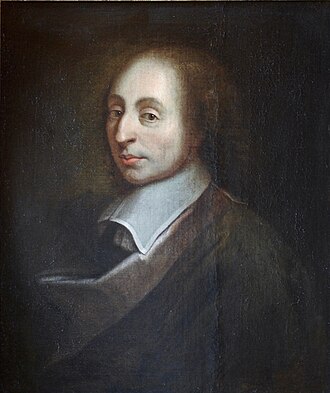 Blaise Pascal
"If, being duke and peer, you would not be contented with my standing uncovered before you, but should also wish that I should esteem you, I should ask you to show me the qualities that merit my esteem. If you did this, you would gain it, and I could not refuse it to you with justice; but if you did not do it, you would be unjust to demand it of me; and assuredly you would not succeed, were you the greatest prince in the world."
Blaise Pascal was a French mathematician, physicist, inventor, philosopher, and Catholic writer.
"Do not imagine that it is less an accident by which you find yourself master of the wealth which you possess, than that by which this man found himself king."
Blaise Pascal"A few rules include all that is necessary for the perfection of the definitions, the axioms, and the demonstrations, and consequently of the entire method of the geometrical proofs of the art of persuading."
Blaise Pascal"When I consider the short duration of my life, swallowed up in the eternity before and after, the small space which I fill, or even can see, engulfed in the infinite immensity of spaces whereof I know nothing, and which know nothing of me, I am terrified, and wonder that I am here rather than there, for there is no reason why here rather than there, or now rather than then. Who has set me here? By whose order and design have this place and time been destined for me?—Memoria hospitis unius diei prætereuntis. It is not well to be too much at liberty. It is not well to have all we want. How many kingdoms know nothing of us! The eternal silence of these infinite spaces alarms me."
Blaise Pascal"God is surrounded with people full of love who demand of him the benefits of love which are in his power: thus he is properly the king of love."
Blaise Pascal"These philosophers of the world place contrarieties in the same subject; for the one attributed greatness to nature and the other weakness to this same nature, which could not subsist; whilst faith teaches us to place them in different subjects: all that is infirm belonging to nature, all that is powerful belonging to grace. Such is the marvelous and novel union which God alone could teach, and which he alone could make, and which is only a type and an effect of the ineffable union of two natures in the single person of a Man-God."
Blaise Pascal"People almost invariably arrive at their beliefs not on the basis of proof but on the basis of what they find attractive."
Blaise Pascal