Quote
"The advancement of the arts, from year to year, taxes our credulity and seems to presage the arrival of that period when human improvement must end."
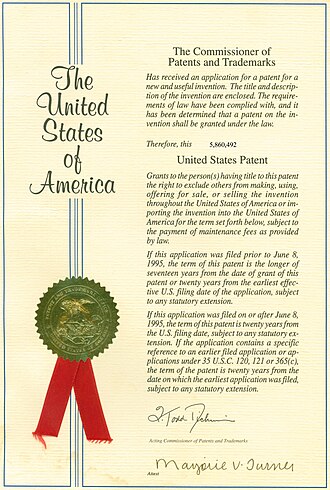 Patent
"If one does not know whether a system “as a whole” (in contrast to certain features of it) is good or bad, the safest “policy conclusion” is to “muddle through” – either with it, if one has long lived with it, or without it, if one has lived without it... If we did not have a patent system, it would be irresponsible, on the basis of our present knowledge of its economic consequences, to recommend instituting one. But since we have had a patent system for a long time, it would be irresponsible, on the basis of our present knowledge, to recommend abolishing it. This last statement refers to a country such as the United States of America – not to a small country and not a predominantly nonindustrial country, where a different weight of argument might well suggest another conclusion..."
A patent is a type of intellectual property that gives its owner the legal right to exclude others from making, using, or selling an invention for a limited period of time, in exchange for publishing an enabling disclosure of the invention. It offers a bargain between society and inventor: for a limited period of exclusivity, the inventor agrees to make the invention public rather than to keep it
"The advancement of the arts, from year to year, taxes our credulity and seems to presage the arrival of that period when human improvement must end."
Patent"In the field of industrial patents in particular we shall have seriously to examine whether the award of a monopoly privilege is really the most appropriate and effective form of reward for the kind of risk bearing which investment in scientific research involves."
Patent"Between 1820 and 1845, only 19 percent of patentees in the United States had parents who were professionals or were from recognizable major landowning families. During the same period, 40 percent of those who took out patents had only primary schooling or less, just like Edison. Moreover, they often exploited their patent by starting a firm, again like Edison. Just as the United States in the nineteenth century was more democratic politically than almost any other nation in the world at the time, it was also more democratic than others when it came to innovation. This was critical to its path to becoming the most economically innovative nation in the world"
Patent"Software patents may be used as a form of outright coercion, providing protection against theft of ideas as a potentially high cost to future inventors."
Patent"The days are over when technology can be advanced in laboratories by individual scientists alone. Now you need an army of lawyers to negotiate the hazardous terrain of interlocking patents. Unless we find a solution to the problem of interlocking patents, the patent system may actually impede the very innovation it was designed to encourage."
Patent"As more and more good ideas come under the protection of patents, it may become increasingly unlikely that any one program can incorporate the state of the art in user-interface design without sinking into a quagmire of unending royalty payments and legal battles."
Patent"As long as you keep getting born, it’s okay to die sometimes."
"The smart way to keep people passive and obedient is to strictly limit the spectrum of acceptable opinion, but allow very lively debate within that spectrum - even encourage the more critical and dissident views. That gives people the sense that theres free thinking going on, while all the time the presuppositions of the system are being reinforced by the limits put on the range of the debate."
"History is a strange experience. The world is quite small now; but history is large and deep. Sometimes you can go much farther by sitting in your own home and reading a book of history, than by getting onto a ship or an airplane and traveling a thousand miles. When you go to Mexico City through space, you find it a sort of cross between modern Madrid and modern Chicago, with additions of its own; but if you go to Mexico City through history, back only 500 years, you will find it as distant as though it were on another planet: inhabited by cultivated barbarians, sensitive and cruel, highly organized and still in the Copper Age, a collection of startling, of unbelievable contrasts."
"As soon as a thought or word becomes a tool, one can dispense with actually ‘thinking’ it, that is, with going through the logical acts involved in verbal formulation of it. As has been pointed out, often and correctly, the advantage of mathematics—the model of all neo-positivistic thinking—lies in just this ‘intellectual economy.’ Complicated logical operations are carried out without actual performance of the intellectual acts upon which the mathematical and logical symbols are based. … Reason … becomes a fetish, a magic entity that is accepted rather than intellectually experienced."
"Our feminist culture at the present moment is completely dependent on capitalism. My grandmother was still scrubbing clothes on the back porch on a washboard!"
"A word of the faith that never balks, Here or henceforward it is all the same to me, I accept Time absolutely. It alone is without flaw, it alone rounds and completes all, That mystic baffling wonder alone completes all. (23)"