Quote
"The advancement of the arts, from year to year, taxes our credulity and seems to presage the arrival of that period when human improvement must end."
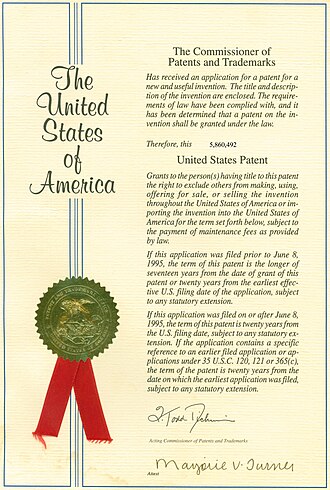 Patent
"The days are over when technology can be advanced in laboratories by individual scientists alone. Now you need an army of lawyers to negotiate the hazardous terrain of interlocking patents. Unless we find a solution to the problem of interlocking patents, the patent system may actually impede the very innovation it was designed to encourage."
A patent is a type of intellectual property that gives its owner the legal right to exclude others from making, using, or selling an invention for a limited period of time, in exchange for publishing an enabling disclosure of the invention. It offers a bargain between society and inventor: for a limited period of exclusivity, the inventor agrees to make the invention public rather than to keep it
"The advancement of the arts, from year to year, taxes our credulity and seems to presage the arrival of that period when human improvement must end."
Patent"In the field of industrial patents in particular we shall have seriously to examine whether the award of a monopoly privilege is really the most appropriate and effective form of reward for the kind of risk bearing which investment in scientific research involves."
Patent"Between 1820 and 1845, only 19 percent of patentees in the United States had parents who were professionals or were from recognizable major landowning families. During the same period, 40 percent of those who took out patents had only primary schooling or less, just like Edison. Moreover, they often exploited their patent by starting a firm, again like Edison. Just as the United States in the nineteenth century was more democratic politically than almost any other nation in the world at the time, it was also more democratic than others when it came to innovation. This was critical to its path to becoming the most economically innovative nation in the world"
Patent"Software patents may be used as a form of outright coercion, providing protection against theft of ideas as a potentially high cost to future inventors."
Patent"If one does not know whether a system “as a whole” (in contrast to certain features of it) is good or bad, the safest “policy conclusion” is to “muddle through” – either with it, if one has long lived with it, or without it, if one has lived without it... If we did not have a patent system, it would be irresponsible, on the basis of our present knowledge of its economic consequences, to recommend instituting one. But since we have had a patent system for a long time, it would be irresponsible, on the basis of our present knowledge, to recommend abolishing it. This last statement refers to a country such as the United States of America – not to a small country and not a predominantly nonindustrial country, where a different weight of argument might well suggest another conclusion..."
Patent"As more and more good ideas come under the protection of patents, it may become increasingly unlikely that any one program can incorporate the state of the art in user-interface design without sinking into a quagmire of unending royalty payments and legal battles."
Patent"The smart way to keep people passive and obedient is to strictly limit the spectrum of acceptable opinion, but allow very lively debate within that spectrum - even encourage the more critical and dissident views. That gives people the sense that theres free thinking going on, while all the time the presuppositions of the system are being reinforced by the limits put on the range of the debate."
"There is no ethical idea which it [dharma] has not stressed, put in its most ideal and imperative form, enforced by teaching, injunction, parable, artistic creation, formative examples. Truth, honour, loyalty, fidelity, courage, chastity, love, long-suffering, self-sacrifice, harmlessness, forgiveness, compassion, benevolence, beneficence are its common themes, are, in its view, the very stuff of a right human life, the essence of mans dharma. Buddhism, with its high and noble ethics, Jainism, with its austere ideal of self-conquest, Hinduism, with its magnificent examples of all sides of the Dharma, are not inferior in ethical teaching and practice to any religion or system, but rather take the highest rank and have had the strongest effective force."
"Moving forward will not be for the faint of heart. But if the next century witnesses failure, let it be because our science is not yet up to the job, not because we dont have the courage to make less random the sometimes most unfair courses of human evolution."
"Our units of temporal measurement, from seconds on up to months, are so complicated, asymmetrical and disjunctive so as to make coherent mental reckoning in time all but impossible. Indeed, had some tyrannical god contrived to enslave our minds to time, to make it all but impossible for us to escape subjection to sodden routines and unpleasant surprises, he could hardly have done better than handing down our present system. It is like a set of trapezoidal building blocks, with no vertical or horizontal surfaces, like a language in which the simplest thought demands ornate constructions, useless particles and lengthy circumlocutions. Unlike the more successful patterns of language and science, which enable us to face experience boldly or at least level-headedly, our system of temporal calculation silently and persistently encourages our terror of time. ... It is as though architects had to measure length in feet, width in meters and height in ells; as though basic instruction manuals demanded a knowledge of five different languages. It is no wonder then that we often look into our own immediate past or future, last Tuesday or a week from Sunday, with feelings of helpless confusion."
"We must present democracy as a force holding within itself the seeds of unlimited progress by the human race. By our actions we should make it clear that such a democracy is a means to a better way of life, together with a better understanding among nations. Tyranny inevitably must retire before the tremendous moral strength of the gospel of freedom and self-respect for the individual, but we have to recognize that these democratic principles do not flourish on empty stomachs, and that people turn to false promises of dictators because they are hopeless and anything promises something better than the miserable existence that they endure. However, material assistance alone is not sufficient. The most important thing for the world today in my opinion is a spiritual regeneration which would reestablish a feeling of good faith among men generally. Discouraged people are in sore need of the inspiration of great principles. Such leadership can be the rallying point against intolerance, against distrust, against that fatal insecurity that leads to war. It is to be hoped that the democratic nations can provide the necessary leadership."
"James Baker was the only leader in America who had the guts to stand up and act against Israels malignant disease: the settlements. When he was the Secretary of State, he simply informed the Israeli government that he would deduct the sums expended on the settlements from the money Israel was getting from the US. Threatened and made good on his threat. Baker thus confronted the "pro-Israeli" lobby in the US, both the Jewish and the Christian. Such courage is rare in the United States, as it is rare in Israel."