SHAWORDS

If our highly pointed Triangles of the Soldier class are formidable, i — Edwin Abbott Abbott

"If our highly pointed Triangles of the Soldier class are formidable, it may be readily inferred that far more formidable are our Women. For if a Soldier is a wedge, a Woman is a needle; being, so to speak, ALL point, at least at the two extremities. Add to this the power of making herself practically invisible at will, and you will perceive that a Female, in Flatland, is a creature by no means to be trifled with."
Edwin Abbott Abbott
Edwin Abbott Abbott
Edwin Abbott Abbott
author30 quotes

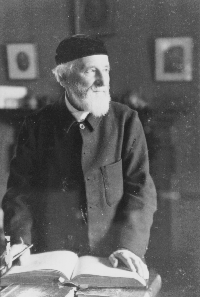
Edwin Abbott Abbott was an English schoolmaster, theologian, and Anglican priest, best known as the author of the novella Flatland (1884).

More by Edwin Abbott Abbott

View all →
Quote
"I devoted several months in privacy to the composition of a treatise on the mysteries of Three Dimensions. Only, with the view of evading the Law, if possible, I spoke not of a physical Dimension, but of a Thoughtland whence, in theory, a Figure could look down upon Flatland and see simultaneously the insides of all things, and where it was possible that there might be supposed to exist a Figure environed, as it were, with six Squares, and containing eight terminal Points. But in writing this book I found myself sadly hampered by the impossibility of drawing such diagrams as were necessary for my purpose... my life was under a cloud. All pleasures palled upon me; all sights tantalized and tempted me to outspoken treason, because I could not but compare what I saw in Two Dimensions with what it really was if seen in Three, and could hardly refrain from making my comparisons aloud. I neglected my clients and my own business to give myself to the contemplation of the mysteries which I had once beheld, yet which I could impart to no one, and found daily more difficult to reproduce even before my own mental vision."
Edwin Abbott AbbottEdwin Abbott Abbott
Quote
"When our Lord uttered (or implied) the words "Do this in remembrance of me," He meant "Do as I am doing." And what He was doing was not a mere "dealing" of "bread" but a "drawing out" of the "soul." This view does not deny that He also contemplated a continuous celebration of the evening meal of thanksgiving in future generations; but it asserts something more, namely, that He meant a spiritual act, "Draw out your souls to one another, and for one another, according to your ability, even as I give my soul, my complete self, delivering it up to you as a gift, and for you as a sacrifice." There is nothing contrary to history and historical development in the belief that Christ taught this doctrine — of self-sacrifice, or losing the soul, of giving the soul as a ransom for others, or drawing out the soul to those in need of help."
Edwin Abbott AbbottEdwin Abbott Abbott
Quote
"Nature herself supplies us with an ascending scale or Alphabet of angles for half a degree up to 60 degrees, Specimens of which are placed in every Elementary School throughout the land. Owing to occasional retrogressions, to still more frequent moral and intellectual stagnation, and to the extraordinary fecundity of the Criminal and Vagabond Classes, there is always a vast superfluity of individuals of the half degree and single degree class, and a fair abundance of Specimens up to 10 degrees. These are absolutely destitute of civic rights; and a great number of them, not having even intelligence enough for the purposes of warfare, are devoted by the States to the service of education. Fettered immovably so as to remove all possibility of danger, they are placed in the class rooms of our Infant Schools, and there they are utilized by the Board of Education for the purpose of imparting to the offspring of the Middle Classes that tact and intelligence of which these wretched creatures themselves are utterly devoid."
Edwin Abbott AbbottEdwin Abbott Abbott
Quote
"The Fourth Gospel is admitted by all Greek scholars to be, in parts, extraordinarily obscure. No honest writer of history is obscure, as a rule, except through carelessness or ignorance — ignorance, it may be, of the art of writing, or of the subject he is writing about, or of the persons he is addressing, or of the words he is using, but, in any case, ignorance of something. But an honest writer of poetry or prophecy may be consciously obscure because a message, so to speak, has come into his mind in a certain form, and he feels this likely to prove the best form — ultimately, when his readers have thought about it."
Edwin Abbott AbbottEdwin Abbott Abbott
Quote
"As soon as the sound of the Peace-cry of my departing Wife had died away, I began to approach the Stranger with the intention of taking a nearer view and of bidding him be seated: but his appearance struck me dumb and motionless with astonishment. Without the slightest symptoms of angularity he nevertheless varied every instant with gradations of size and brightness scarcely possible for any Figure within the scope of my experience. The thought flashed across me that I might have before me a burglar or cut-throat, some monstrous Irregular Isosceles, who, by feigning the voice of a Circle, had obtained admission somehow into the house, and was now preparing to stab me with his acute angle."
Edwin Abbott AbbottEdwin Abbott Abbott

More on Dil

View all →
Quote
"Mister Toombs was willing to dissolve the Union to save slavery, Mister Phillips, to save liberty; while Mister Seward, denounced and derided by both, declared that the deepest instinct of the American people was for union. Reserved rights. State rights, limited powers, the advantages of union and disunion, were the cucumbers from which we were busily engaged in distilling light, overlooking the fact of nationality in discussing the conditions of union. We were speculating upon costume. We gravely proved that the clothes were the clothes of a woman, or of a child, without seeing that whatever the clothes might be there was a full-grown man inside of them. "The Constitution is a contract between sovereign States", shouted Mister Toombs, "let Georgia tear it and separate". "The Constitution is a league with hell", calmly replied Mister Phillips, "let New York cut off New Orleans to rot alone". "Oh, dear! it"s a dreadful dilemma", whimpered President Buchanan. "States have no right to secede, and the United States have no right to coerce. Oh, dear me! it"s perfectly awful! I"m the most patriotic of men, but what shall I do? what shall I do?" Separate! Cut off! Secede! It was of a living body they spoke, which, pierced anywhere, quivered everywhere."
Wendell PhillipsWendell Phillips
Quote
"Its never a matter of ethics versus pragmatism; its a question of which informs the other. Humans have shown themselves capable of almost unlimited imagination and innovation—qualities that could be said to define human beings. People have used this capacity to do both great good and great harm. The point is that when humans set their minds to doing something, its frequently possible. It makes sense to first ask what people want to do and why, from an ethical standpoint, and then get to the pragmatic how-to questions. The very process of asking whats right is how people fill out ethics in praxis, to meet new demands and dilemmas, new social conditions and contexts. Anarchism, then, brings an egalitarian ethics out into the world, making it transparent, public, and shared. It maintains an ethical orientation, while continually trying to put such notions into practice, as flawed as the effort might be. When other people come into contact with this ethical compass, they will hopefully "get it" and incorporate the same values into their lives, because it works. It offers directionality to political involvement and buttresses peoples efforts to remake society. It turns surviving into thriving. Thats the crucial difference between a pragmatic versus ethical impulse: people, in cooperative concert, qualitatively transform one anothers lives."
E
Ethics
Quote
"Thats... the big discovery of this principle of computational equivalence of mine. ...This is something which is kind of a follow-on to Gödels theorem, to Turings work on the ... that there is this fundamental limitation built into science, this idea of computational irreducibility that says that even though you may know the rules by which something operates, that does not mean that you can readily... be smarter that it and jump ahead and figure out what its going to do."
S
Stephen Wolfram
Quote
"The establishment of "The Times" newspaper is an example, on a large scale, of a manufactory in which the division of labour, both mental and bodily, is admirably illustrated, and in which also the effect of domestic economy is well exemplified. It is scarcely imagined, by the thousands who read that paper in various quarters of the globe, what a scene of organized activity the factory presents during the whole night, or what a quantity of talent and mechanical skill is put in action for their amusement and information."
Charles BabbageCharles Babbage