Quote
"Warrior spirit is characterised by direct, clear and loyal relations, based on fidelity and honour and a sound instinct for the various dignities, which it can well distinguish: it opposes everything which is impersonal and trivial."
"In a superior civilization, as, for example, that of the Indo-Aryans, the being who is without a characteristic form or caste (in the original meaning of the word), not even that of servant or shudra, would emerge as a pariah. In this respect America is a society of pariahs. There is a role for pariahs. It is to be subjected to beings whose form and internal laws are precisely defined. Instead the modern pariahs seek to become dominant themselves and to exercise their dominion over the entire world."

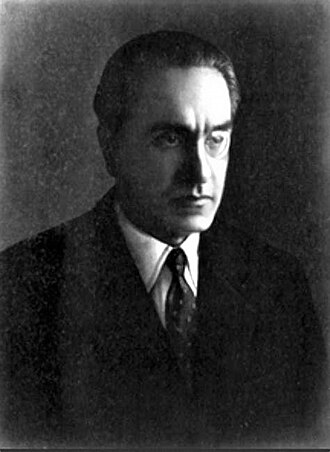
Giulio Cesare Andrea "Julius" Evola was an Italian far-right philosopher and writer. Evola regarded his values as traditionalist, aristocratic, martial and imperialist. An esoteric thinker in Fascist Italy, he also had ties to Nazi Germany. In the post-war era, he was an ideological mentor of the Italian neo-fascist and militant right.
"Warrior spirit is characterised by direct, clear and loyal relations, based on fidelity and honour and a sound instinct for the various dignities, which it can well distinguish: it opposes everything which is impersonal and trivial."
"It is a cliché that the modern scientific vision has desacralized the world, and the world desacralized by scientific knowledge has become one of the existential elements that make up modern man, all the more so to the degree that he is "civilized." Ever since he has been subject to compulsory education, his mind has been stuffed with "positive" scientific notions; he cannot avoid seeing in a soulless light everything that surrounds him, and therefore acts destructively. What, for example, could the symbol of the sunset of a dynasty, like the Japanese, mean to him when he knows scientifically what the sun is: merely a star, at which one can even fire missiles."
"Prussia had been the creation of a dynasty that had the nobility, the army and the higher bureaucracy for its backbone. The primary element was not the nation or the Volk. Rather the state, more than the land or the ethnos, constituted the real foundation and unifying principle. There was none of that in Hitlerism."
"The lesser war here corresponds to the exoteric war, the bloody battle which is fought with material arms against the enemy, against the barbarian, against an inferior race over whom a superior right is claimed, or, finally, when the event is motivated by a religious justification, against the infidel. No matter how terrible and tragic the events, no matter how huge the destruction, this war, metaphysically, still remains a lesser war. The greater or holy war is, contrarily, of the interior and intangible order – it is the war which is fought against the enemy, the barbarian, the infidel, whom everyone bears in himself, or whom everyone can see arising in himself on every occasion that he tries to subject his whole being to a spiritual law."
"The highest instrument of inner awakening of race is combat, and war is its highest expression. That pacifism and humanitarianism are phenomena closely linked to internationalism, democracy, cosmopolitanism and liberalism is perfectly logical – the same anti-racial instinct present in some, is reflected and confirmed in the others. The will towards sub-racial levelling inborn in internationalism finds its ally in pacifist humanitarianism, which has the function of preventing the heroic test from disrupting the game by galvanising the surviving forces of any still not completely deracinated peoples."
"As a social bond, now one does not find even a faith of the warrior kind, that is, relationships of loyalty and honour. The social bond assumes a utilitarian and economic character; it is an agreement based on convenience and material interest — a type only a merchant would accept."