Quote
"One of the great mistakes is to judge policies and programs by their intentions rather than their results."
M
Milton Friedman"It does harm a great many other people, but primarily because its prohibited. There are an enormous number of innocent victims now. Youve got the people whose purses are stolen, who are bashed over the head by people trying to get enough money for their next fix. Youve got the people killed in the random drug war. Youve got the corruption of the legal establishment. Youve got the innocent victims who are taxpayers who have to pay for more and more prisons, and more and more prisoners, and more and more police. Youve got the rest of us who dont get decent law enforcement because all the law enforcement officials are busy trying to do the impossible. And, last, but not least, youve got the people of Colombia and Peru and so on. What business do we have destroying and leading to the killing of thousands of people in Colombia because we cannot enforce our own laws? If we could enforce our laws against drugs, there would be no market for these drugs."
Milton Friedman was an American economist and statistician who received the 1976 Nobel Memorial Prize in Economic Sciences for his research on consumption analysis, monetary history and theory and the complexity of stabilization policy. With George Stigler, Friedman was among the intellectual leaders of the Chicago school of economics, a neoclassical school of economic thought associated with the
"One of the great mistakes is to judge policies and programs by their intentions rather than their results."
"To paraphrase Clemenceau, money is much too serious a matter to be left to the Central Bankers."
"Now, I don’t want to put Friedman on a pedestal. In fact, I’d argue that the experience of the past 15 years, first in Japan and now across the Western world, shows that Keynes was right and Friedman was wrong about the ability of unaided monetary policy to fight depressions. The truth is that we need a more activist government than Friedman was willing to countenance. The point, however, is that modern conservatism has moved so far to the right that it no longer has room for even small concessions to reality. Friedman tried to save free-market conservatism from itself — but the ideologues who now dominate the G.O.P. are beyond saving."
"Corruption is government intrusion into market efficiencies in the form of regulations."
"Why should they also be accepted by private persons in private transactions in exchange for goods and services? The short answer—and the right answer—is that private persons accept these pieces of paper because they are confident that others will. The pieces of green paper have value because everybody thinks they have value. Everybody thinks they have value because in everybodys experience they have had value..."
"On the whole, the monetarism for which Friedman first became famous seems clever, brilliantly argued, but shallow—and perhaps even a bit disingenuous. Friedmans writings from that period have the feel of a smart man who knows what he wants to believe looking hard for supporting arguments."
"I say this to you because we Spaniards are a forgetful people, because we are used to living for the moment, because we do not look back, because we do not know how to see the chain of heroes, because we do not contemplate the sum of sacrifices."
 Francisco Franco
"If it fulfills our hopes, this center will be, at once, a symbol and a reflection and a hope. It will symbolize our belief that the world of creation and thought are at the core of all civilization. Only recently in the White House we helped commemorate the 400th anniversary of Shakespeare. The political conflicts and ambitions of his England are known to the scholar and to the specialist. But his plays will forever move men in every corner of the world. The leaders that he wrote about live far more vividly in his words than in the almost forgotten facts of their own rule. Our civilization, too, will largely survive in the works of our creation. There is a quality in art which speaks across the gulf dividing man from man and nation from nation, and century from century. That quality confirms the faith that our common hopes may be more enduring than our conflicting hostilities. Even now men of affairs are struggling to catch up with the insights of great art. The stakes may well be the survival of civilization. The personal preferences of men in government are not important--except to themselves. However, it is important to know that the opportunity we give to the arts is a measure of the quality of our civilization. It is important to be aware that artistic activity can enrich the life of our people, which really is the central object of Government. It is important that our material prosperity liberate and not confine the creative spirit."
"There was a man and he had eight sons. Apart from that, he was nothing more than a comma on the page of History. Its sad, but thats all you can say about some people."
"Children must be free to think in all directions irrespective of the peculiar ideas of parents who often seal their childrens minds with preconceived prejudices and false concepts of past generations. Unless we are very careful, very careful indeed, and very conscientious, there is still great danger that our children may turn out to be the same kind of people we are."
"I hear people say I swing at bad pitches. What is a bad pitch? If I can hit it, its not a bad pitch."
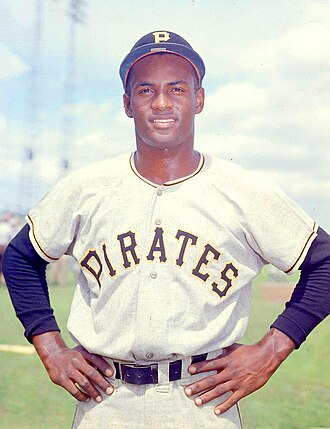 Roberto Clemente
"A free people will always refuse to put up with preventable poverty. If freedom is to be saved and enlarged, poverty must be ended. There is no other solution. The problem of how to prevent these three forces from coming into head-on collision is the principal study of the more politically conscious Conservative leaders. How can wealth persuade poverty to use its political freedom to keep wealth in power? Here lies the whole art of Conservative politics in the twentieth century."