Quote
"I object to a quarrel because it always interrupts an argument."
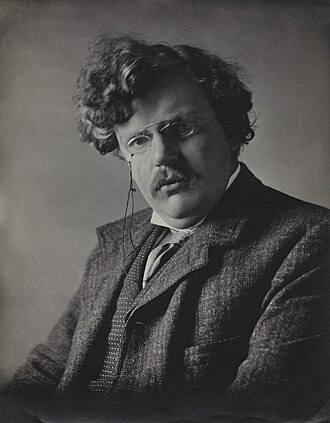 G. K. Chesterton
"Let me explain a little: Certain things are bad so far as they go, such as pain, and no one, not even a lunatic, calls a tooth-ache good in itself; but a knife which cuts clumsily and with difficulty is called a bad knife, which it certainly is not. It is only not so good as other knives to which men have grown accustomed. A knife is never bad except on such rare occasions as that in which it is neatly and scientifically planted in the middle of ones back. The coarsest and bluntest knife which ever broke a pencil into pieces instead of sharpening it is a good thing in so far as it is a knife. It would have appeared a miracle in the Stone Age. What we call a bad knife is a good knife not good enough for us; what we call a bad hat is a good hat not good enough for us; what we call bad cookery is good cookery not good enough for us; what we call a bad civilization is a good civilization not good enough for us. We choose to call the great mass of the history of mankind bad, not because it is bad, but because we are better. This is palpably an unfair principle. Ivory may not be so white as snow, but the whole Arctic continent does not make ivory black."
Gilbert Keith Chesterton was an English Christian apologist writer. Chesterton's wit, paradoxical style, and defence of tradition made him a dominant figure in early 20th-century literature.
"I object to a quarrel because it always interrupts an argument."
G. K. Chesterton"Earnest Freethinkers need not worry themselves so much about the persecutions of the past. Before the Liberal idea is dead or triumphant we shall see wars and persecutions the like of which the world has never seen."
G. K. Chesterton"Impartiality is a pompous name for indifference, which is an elegant name for ignorance."
G. K. Chesterton"The simplification of anything is always sensational."
G. K. Chesterton"There is only one thing that it requires real courage to say, and that is a truism."
G. K. Chesterton"When fishes flew and forests walked And figs grew upon thorn, Some moment when the moon was blood Then surely I was born. With monstrous head and sickening cry And ears like errant wings, The devil’s walking parody On all four-footed things."
G. K. Chesterton"As long as you keep getting born, it’s okay to die sometimes."
"The smart way to keep people passive and obedient is to strictly limit the spectrum of acceptable opinion, but allow very lively debate within that spectrum - even encourage the more critical and dissident views. That gives people the sense that theres free thinking going on, while all the time the presuppositions of the system are being reinforced by the limits put on the range of the debate."
"History is a strange experience. The world is quite small now; but history is large and deep. Sometimes you can go much farther by sitting in your own home and reading a book of history, than by getting onto a ship or an airplane and traveling a thousand miles. When you go to Mexico City through space, you find it a sort of cross between modern Madrid and modern Chicago, with additions of its own; but if you go to Mexico City through history, back only 500 years, you will find it as distant as though it were on another planet: inhabited by cultivated barbarians, sensitive and cruel, highly organized and still in the Copper Age, a collection of startling, of unbelievable contrasts."
"As soon as a thought or word becomes a tool, one can dispense with actually ‘thinking’ it, that is, with going through the logical acts involved in verbal formulation of it. As has been pointed out, often and correctly, the advantage of mathematics—the model of all neo-positivistic thinking—lies in just this ‘intellectual economy.’ Complicated logical operations are carried out without actual performance of the intellectual acts upon which the mathematical and logical symbols are based. … Reason … becomes a fetish, a magic entity that is accepted rather than intellectually experienced."
"Our feminist culture at the present moment is completely dependent on capitalism. My grandmother was still scrubbing clothes on the back porch on a washboard!"
"A word of the faith that never balks, Here or henceforward it is all the same to me, I accept Time absolutely. It alone is without flaw, it alone rounds and completes all, That mystic baffling wonder alone completes all. (23)"