SHAWORDS

Roger Bacon had shown how easy it is, and how vain, to survey the oper — Roger Bacon

HomeRoger BaconQuote
"Roger Bacon had shown how easy it is, and how vain, to survey the operations of Nature and idly refer her wondrous works to chance or accident, or to the immediate interposition of God."
Roger Bacon
Roger Bacon
Roger Bacon
author26 quotes

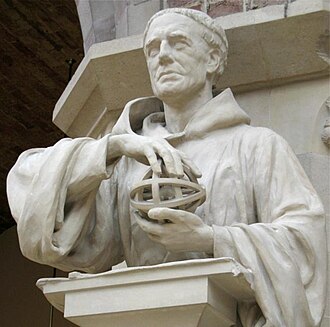
Roger Bacon, also known by the scholastic accolade Doctor Mirabilis, was a medieval English polymath, philosopher, scientist, theologian and Franciscan friar who placed considerable emphasis on the study of nature through empiricism. Intertwining his Catholic faith with scientific thinking, Roger Bacon is considered one of the greatest polymaths of the medieval period.

More by Roger Bacon

View all →
Quote
"For sounds like thunder, and coruscations like lightning, may be made in the air, and they may be rendered even more horrible than those of nature herself. A small quantity of matter, properly manufactured, not larger than the human thumb, may be made to produce a horrible noise and coruscation. And this may be done many ways, by which a city or an army may be destroyed, as was the case when and his men broke their pitchers and exhibited their lamps, fire issuing out of them with inestimable noise, destroyed an infinite number of the army of the Midianites."
Roger BaconRoger Bacon
Quote
"One man I know, and one only, who can be praised for his achievements in this science. Of discourses and battles of words he takes no heed: he follows the works of wisdom, and in these finds rest. What others strive to see dimly and blindly, like bats in twilight, he gazes at in the full light of day, because he is a master of experiment. Through experiment he gains knowledge of natural things, medical, chemical, indeed of everything in the heavens or earth. He is ashamed that things should be known to laymen, old women, soldiers, ploughmen, of which he is ignorant. Therefore he has looked closely into the doings of those who work in metals and minerals of all kinds; he knows everything relating to the art of war, the making of weapons, and the chase; he has looked closely into agriculture, mensuration, and farming work; he has even taken note of the remedies, lot casting, and charms used by old women and by wizards and magicians, and of the deceptions and devices of conjurors, so that nothing which deserves inquiry should escape him, and that he may be able to expose the falsehoods of magicians. If philosophy is to be carried to its perfection and is to be handled with utility and certainty, his aid is indispensable. As for reward, he neither receives nor seeks it. If he frequented kings and princes, he would easily find those who would bestow on him honours and wealth. Or, if in Paris he would display the results of his researches, the whole world would follow him. But since either of these courses would hinder him from pursuing the great experiments in which he delights, he puts honour and wealth aside, knowing well that his wisdom would secure him wealth whenever he chose. For the last three years he has been working at the production of a mirror that shall produce combustion at a fixed distance; a problem which the Latins have neither solved nor attempted, though books have been written upon the subject."
Roger BaconRoger Bacon

More on Nature

View all →
Quote
"Are people naturally destructive, immoral, predatory and self-seeking, only to be kept in order by harsh laws and fiercely deterrent mandatory sentences? Or are men and women naturally orderly, merciful, humane and bred with a need for justice and mutual aid? Of course these qualities, or defects, are not evenly distributed, and undoubtedly there is much of each in all of us, but when it comes to the law some sort of distinction can be drawn. Are you a Shylock or a Bassanio? Shylock pinned his faith on the words in the contract, the nature of his bond and the duty of the state to uphold the letter of the law regardless of human suffering. Bassanio put another point of view. More important than the sanctity of the law was the plight of the individual parties in the particular case."
J
John Mortimer