Quote
"Form or figure is space limited by boundaries. Space has necessarily three dimensions, length, breadth, depth; and no ethers which cannot be resolved into these."
W
William Whewell"The " Five Words," genus, species, difference, property, accident, were used by the Aristotelians, in order to express the subordination of kinds, and to describe the nature of definitions and propositions. In modern times, these technical expressions have been more referred to by Natural Historians than by Metaphysicians."
William Whewell was an English polymath. He was Master of Trinity College, Cambridge. In his time as a student there, he achieved distinction in both poetry and mathematics.
"Form or figure is space limited by boundaries. Space has necessarily three dimensions, length, breadth, depth; and no ethers which cannot be resolved into these."
"A Natural System is one which attempts to make all the divisions natural, the widest as well as the narrowest; and therefore applies no characters peremptorily."
"According to the technical language of old writers, a thing and its qualities are described as subject and attributes; and thus a man’s faculties and acts are attributes of which he is the subject. The mind is the subject in which ideas inhere. Moreover, the man’s faculties and acts are employed upon external objects; and from objects all his sensations arise. Hence the part of a man’s knowledge which belongs to his own mind, is subjective: that which flows in upon him from the world external to him, is objective."
"We cannot observe external things without some degree of Thought; nor can we reflect upon our Thoughts, without being influenced in the course of our reflection by the Things which we have observed."
"We unfold out of the Idea of Space the propositions of geometry, which are plainly truths of the most rigorous necessity and universality. But if the idea of space were merely collected from observation of the external world, it could never enable or entitle us to assert such propositions: it could never authorize us to say that not merely some lines, but all lines, not only have, but must have, those properties which geometry teaches. Geometry in every proposition speaks a language which experience never dares to utter; and indeed of which she but half comprehends the meaning."
"The antithesis of Sense & Ideas is the foundation of the Philosophy of Science. No knowledge can exist without the union, no philosophy without the separation, of these two elements."
"In the life of the mass-order, the culture of the generality tends to conform to the demands of the average human being. Spirituality decays through being diffused among the masses when knowledge is impoverished in every possible way by rationalisation until it becomes accessible to the crude understanding of all."
"I say this to you because we Spaniards are a forgetful people, because we are used to living for the moment, because we do not look back, because we do not know how to see the chain of heroes, because we do not contemplate the sum of sacrifices."
 Francisco Franco
"Sharon Tate was my best friend. Once, we were roommates. She introduced me to my husband. She was the godmother to my baby daughter who is named for her. In the six years time that I knew her, she never said an unkind word about anyone."
"Long time to see. (VS: Tapion)"
"Most mathematicians prove what they can, von Neumann proves what he wants." Once in a discussion about the rapid growth of mathematics in modern times, von Neumann was heard to remark that whereas thirty years ago a mathematician could grasp all of mathematics, that is impossible today. Someone asked him: "What percentage of all mathematics might a person aspire to understand today?" Von Neumann went into one of his five-second thinking trances, and said: "About 28 percent."
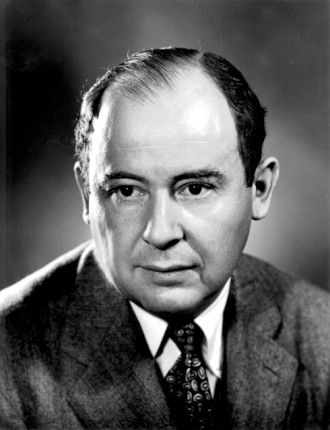 John von Neumann
"Children must be free to think in all directions irrespective of the peculiar ideas of parents who often seal their childrens minds with preconceived prejudices and false concepts of past generations. Unless we are very careful, very careful indeed, and very conscientious, there is still great danger that our children may turn out to be the same kind of people we are."