Quote
"The office of the lawyer, however poorly filled, is too delicate, personal and confidential to be occupied by a corporation."
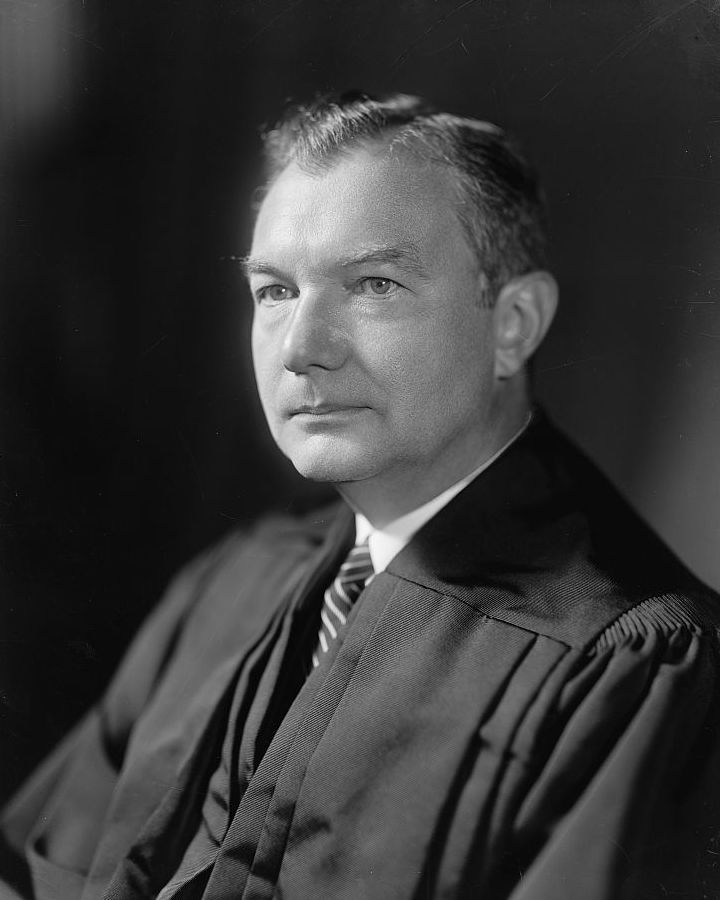 Robert H. Jackson
"There is a most important reason why the prosecutor should have, as nearly as possible, a detached and impartial view of all groups in his community. Law enforcement is not automatic. It isnt blind. One of the greatest difficulties of the position of prosecutor is that he must pick his cases, because no prosecutor can even investigate all of the eases in which he receives complaints. If the department of justice were to make even a pretense of reaching every probable violation of federal law, ten times its present staff would be inadequate. We know that no local police force can strictly enforce the traffic laws, or it would arrest half the driving population on any given morning, [sic!] What every prosecutor is practically required to do is to select the cases for prosecution and to select those in which the offense is the most flagrant, the public harm the greatest, and the proof the most certain."
Robert Houghwout Jackson was an American lawyer, jurist, and politician who served as an associate justice of the U.S. Supreme Court from 1941 until his death in 1954. He had previously served as United States Solicitor General and United States Attorney General, and is the only person to have held all three of those offices. Jackson was also notable for his work at the Nuremberg trials prosecutin
"The office of the lawyer, however poorly filled, is too delicate, personal and confidential to be occupied by a corporation."
Robert H. Jackson"I used to say that, as Solicitor General, I made three arguments in every case. First came the one I had planned – as I thought, logical, coherent, complete. Second was the one actually presented – interrupted, incoherent, disjointed, disappointing. The third was the utterly devastating argument that I thought of after going to bed that night…"
Robert H. Jackson"Our people do not want barren theories from their democracy. Maury Maverick has expressed very quaintly, but clearly, what they really want when he says: We Americans want to talk, pray, think as we please — and eat regular."
Robert H. Jackson"Any prosecutor who risks his day-to-day professional name for fair dealing to build up statistics of success has a perverted sense of practical values, as well as defects of character. Whether one seeks promotion to a. judgeship, as many prosecutors rightly do, or whether he returns to private practice, he can have no better asset than to have his profession recognize that his attitude toward those who feel his power has been dispassionate, reasonable and just."
Robert H. Jackson"In the enforcement of laws that protect our national integrity and existence, we should prosecute any and every act of violation, but only overt acts, not the expression of opinion, or activities such as the holding of meetings, petitioning of congress, or dissemination of news or opinions. Only by extreme care can we protect the spirit as well as the letter of our civil liberties, and to do so is a responsibility of the federal prosecutor."
Robert H. Jackson"He loved his profession, he had a real sense of dedication to the administration of justice, he held his head high as a lawyer, he rendered and exacted courtesy, honor and straightforwardness at the Bar. He respected the judicial office deeply, demanded the highest standards of competence and disinterestedness and dignity, despised all political use of or trifling with judicial power, and had an affectionate regard for every man who filled the exacting prescription of the just judge. The law to him was like a religion, and its practice was more than a means of support; it was a mission. He was not always popular in his community, but he was respected. Unpopular minorities and individuals often found in him their only mediator and advocate. He was too independent to court the populace - he thought of himself as a leader and lawgiver, not a mouthpiece."
Robert H. Jackson"As long as you keep getting born, it’s okay to die sometimes."
"The smart way to keep people passive and obedient is to strictly limit the spectrum of acceptable opinion, but allow very lively debate within that spectrum - even encourage the more critical and dissident views. That gives people the sense that theres free thinking going on, while all the time the presuppositions of the system are being reinforced by the limits put on the range of the debate."
"History is a strange experience. The world is quite small now; but history is large and deep. Sometimes you can go much farther by sitting in your own home and reading a book of history, than by getting onto a ship or an airplane and traveling a thousand miles. When you go to Mexico City through space, you find it a sort of cross between modern Madrid and modern Chicago, with additions of its own; but if you go to Mexico City through history, back only 500 years, you will find it as distant as though it were on another planet: inhabited by cultivated barbarians, sensitive and cruel, highly organized and still in the Copper Age, a collection of startling, of unbelievable contrasts."
"As soon as a thought or word becomes a tool, one can dispense with actually ‘thinking’ it, that is, with going through the logical acts involved in verbal formulation of it. As has been pointed out, often and correctly, the advantage of mathematics—the model of all neo-positivistic thinking—lies in just this ‘intellectual economy.’ Complicated logical operations are carried out without actual performance of the intellectual acts upon which the mathematical and logical symbols are based. … Reason … becomes a fetish, a magic entity that is accepted rather than intellectually experienced."
"Our feminist culture at the present moment is completely dependent on capitalism. My grandmother was still scrubbing clothes on the back porch on a washboard!"
"A word of the faith that never balks, Here or henceforward it is all the same to me, I accept Time absolutely. It alone is without flaw, it alone rounds and completes all, That mystic baffling wonder alone completes all. (23)"