SHAWORDS

There is a notion that complete impartiality is the most fitting and i — Karl Barth

HomeKarl BarthQuote
"There is a notion that complete impartiality is the most fitting and indeed the normal disposition for true exegesis, because it guarantees complete absence of prejudice. For a short time, around 1910, this idea threatened to achieve almost a canonical status in Protestant theology. But now, we can quite calmly describe it as merely comical."
Karl Barth
Karl Barth
Karl Barth
author65 quotes

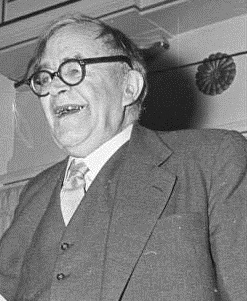
Karl Barth was a Swiss Reformed theologian. Barth is best known for his commentary The Epistle to the Romans, his involvement in the Confessing Church, including his authorship of the Barmen Declaration, and especially his unfinished multi-volume theological summa the Church Dogmatics. Barth's influence expanded well beyond the academic realm to mainstream culture, leading him to be featured on th

More by Karl Barth

View all →
Quote
"Knowledge of God is obedience to God. Observe that we do not say that knowledge of God may also be obedience, or that of necessity it has obedience attached to it, or that it is followed by obedience. No; knowledge of God as knowledge of faith is in itself and of essential necessity obedience. It is an act of human decision corresponding to the act of divine decision; corresponding to the act of the divine being as the living Lord; corresponding to the act of grace in which faith is grounded and continually grounded again in God. In this act God posits Himself as our object and ourselves as those who know Him. But the fact that He does so means that our knowing God can consist only in our following this act, in ourselves becoming a correspondence of this act, in ourselves and our whole existence and therefore our considering and conceiving becoming the human act corresponding to the divine act. This is obedience, the obedience of faith."
Karl BarthKarl Barth
Quote
"At the center of the discussion of the nature of practical theology is the issue of the relation of theory to praxis. If theory precedes and determines practice, then practice tends to be concerned primarily with methods, techniques and strategies for ministry, lacking theological substance. If practice takes priority over theory, ministry tends to be based on pragmatic results rather than prophetic revelation … Barth, from the beginning, resisted all attempts to portray theory and praxis in opposition to one another. In his early Church Dogmatics he described any distinction between “theoretical” and “practical” as a “primal lie, which has to be resisted in principal”. The understanding of Christ as the light of life can be understood only as a “theory which has its origin and goal in praxis”."
Karl BarthKarl Barth
Quote
"One of the cardinal points of Barths doctrine of God is that He is the transcendent God. On every hand Barth is out to set God immensely above the dieties of the world, and the substitutes for God which modern philosophy and scientific research into Natures forces have put into "modern" mans mind. … Barth makes it explicit from the beginning that God is the unknowable and indescribable God. The hidden God remains hidden. Even when we say we know him our knowledge is of an incomprehensible Reality. … Barths contention is summed up in the dictum: Finitum non Capax infiniti, the finite has no capacity for the Infinite. … On every hand Barth speaks of time and eternity as two distinct realms, an unbridged chasm between God and man, and the unknown God."
Karl BarthKarl Barth
Quote
"The name Jesus defines an historical occurence and marks the point where the unknown world cuts the known world . . . as Christ Jesus is the plane which lies beyond our comprehension. The plane which is known to us, He intersects vertically, from above. Within history Jesus as the Christ can be understood only as Problem or Myth. As the Christ He brings the world of the Father. But we who stand in this concrete world know nothing, and are incapable of knowing anything, of that other world. The Resurrection from the dead is, however, the transformation: the establishing or declaration of that point from above, and the corresponding discerning of it below."
Karl BarthKarl Barth
Quote
"He is the One who stands above us and also above our highest and deepest feelings, strivings, intuitions, above the products, even the most sublime, of the human spirit. God in the highest means first of all … He who is in no way established in us, in no way corresponds to a human disposition and possibility, but who is in every sense established simply in Himself and is real in that way; and who is manifest and made manifest to us men, not because of our seeking and finding, feeling and thinking, but again and again, only through Himself. It is this God in the highest who has turned as such to man, given Himself to man, made Himself knowable to him … God in the highest, in the sense of the Christian Confession, means He who from on high has condescended to us, has come to us, has become ours."
Karl BarthKarl Barth
Quote
"The voice of him that crieth in the wilderness, Prepare ye the way of the Lord, make straight in the desert a highway for our God. Every valley shall be exalted, and every mountain and hill shall be made low: and the crooked shall be made straight, and the rough places plain: And the glory of the Lord shall be revealed!" This is the voice of our conscience, telling us of the righteousness of God. And since conscience is the perfect interpreter of life, what it tells us is no question, no riddle, no problem, but a fact — the deepest, innermost, surest fact of life: God is righteous. Our only question is what attitude toward the fact we ought to take. We shall hardly approach the fact with our critical reason. The reason sees the small and the larger but not the large. It sees the preliminary, but not the final, the derived but not the original, the complex but not the simple. It sees what is human but not what is divine. We shall hardly be taught this fact by men."
Karl BarthKarl Barth

More on Time

View all →
Quote
"History is a strange experience. The world is quite small now; but history is large and deep. Sometimes you can go much farther by sitting in your own home and reading a book of history, than by getting onto a ship or an airplane and traveling a thousand miles. When you go to Mexico City through space, you find it a sort of cross between modern Madrid and modern Chicago, with additions of its own; but if you go to Mexico City through history, back only 500 years, you will find it as distant as though it were on another planet: inhabited by cultivated barbarians, sensitive and cruel, highly organized and still in the Copper Age, a collection of startling, of unbelievable contrasts."
G
Gilbert Highet
Quote
"As soon as a thought or word becomes a tool, one can dispense with actually ‘thinking’ it, that is, with going through the logical acts involved in verbal formulation of it. As has been pointed out, often and correctly, the advantage of mathematics—the model of all neo-positivistic thinking—lies in just this ‘intellectual economy.’ Complicated logical operations are carried out without actual performance of the intellectual acts upon which the mathematical and logical symbols are based. … Reason … becomes a fetish, a magic entity that is accepted rather than intellectually experienced."
M
Mathematics