SHAWORDS

What is called "objectivity," scientific for instance (in which I firm — Jacques Derrida

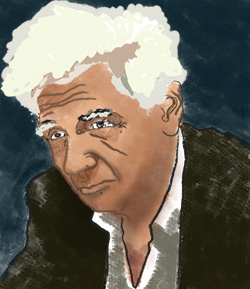
"What is called "objectivity," scientific for instance (in which I firmly believe, in a given situation) imposes itself only within a context which is extremely vast, old, firmly established, or rooted in a network of conventions … and yet which still remains a context."
Jacques Derrida
Jacques Derrida
Jacques Derrida
author40 quotes

Jacques Derrida was a French philosopher. He developed the philosophy of deconstruction, which he utilized in a number of his texts, and which was developed through close readings of the linguistics of Ferdinand de Saussure and Husserlian and Heideggerian phenomenology. He is one of the major figures associated with post-structuralism and postmodern philosophy although he distanced himself from po

More by Jacques Derrida

View all →

More on Self

View all →
Quote
"At one point a heated discussion arose over the possible interpretation of Lolita as a grandiose metaphor of the classic Europeans hopeless love for young, seductive, barbaric America. In his afterword to the novel Nabokov himself mentions this as the naive theory of one of the publishers who turned the book down. And although there cant be the slightest doubt that Nabokov did not mean to limit Lolita to that interpretation, there is no reason to exclude it as one of the novels many dimensions. The point, I felt, became obvious when one drew the line between Lolita as a delightfully frivolous story on the verge of pornography and Lolita as a literary masterpiece, the only convincing love story of our century."
LolitaLolita
Quote
"He was obeyed, yet he inspired neither love nor fear, nor even respect. He inspired uneasiness. That was it! Uneasiness. Not a definite mistrust — just uneasiness — nothing more. You have no idea how effective such a... a... faculty can be. He had no genius for organizing, for initiative, or for order even. That was evident in such things as the deplorable state of the station. He had no learning, and no intelligence. His position had come to him — why? Perhaps because he was never ill . . . He had served three terms of three years out there . . . Because triumphant health in the general rout of constitutions is a kind of power in itself."
H
Heart of Darkness