SHAWORDS
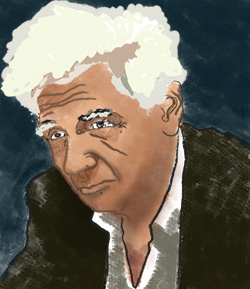
Jacques Derrida

Jacques Derrida

Jacques Derrida

Jacques Derrida

author
40Quotes

Jacques Derrida was a French philosopher. He developed the philosophy of deconstruction, which he utilized in a number of his texts, and which was developed through close readings of the linguistics of Ferdinand de Saussure and Husserlian and Heideggerian phenomenology. He is one of the major figures associated with post-structuralism and postmodern philosophy although he distanced himself from po

Popular Quotes

40 total
Quote
"The dissimulation of the woven texture can in any case take centuries to undo its web: a web that envelops a web, undoing the web for centuries; reconstituting it too as an organism, indefinitely regenerating its own tissue behind the cutting trace, the decision of each reading. There is always a surprise in store for the anatomy or physiology of any criticism that might think it had mastered the game, surveyed all the threads at once, deluding itself, too, in wanting to look at the text without touching it, without laying a hand on the "object," without risking- which is the only chance of entering into the game, by getting a few fingers caught- the addition of some new thread."
Jacques DerridaJacques Derrida
Quote
"Although Saussure recognized the necessity of putting the phonic substance between brackets ("What is essential in language, we shall see, is foreign to the phonic character of the linguistic sign" [p. 21]. "In its essence it [the linguistic signifier] is not at all phonic" [p. 164]), Saussure, for essential, and essentially metaphysical, reasons had to privilege speech, everything that links the sign to phone. He also speaks of the "natural link" between thought and voice, meaning and sound (p. 46). He even speaks of "thought-sound" (p. 156). I have attempted elsewhere to show what is traditional in such a gesture, and to what necessities it submits. In any event, it winds up contradicting the most interesting critical motive of the Course, making of linguistics the regulatory model, the "pattern" for a general semiology of which it was to be, by all rights and theoretically, only a part. The theme of the arbitrary, thus, is turned away from its most fruitful paths (formalization) toward a hierarchizing teleology:... One finds exactly the same gesture and the same concepts in Hegel. The contradiction between these two moments of the Course is also marked by Saussures recognizing elsewhere that "it is not spoken language that is natural to man, but the faculty of constituting a language, that is, a system of distinct signs … ," that is, the possibility of the code and of articulation, independent of any substance, for example, phonic substance."
Jacques DerridaJacques Derrida
Quote
"2) "the a of différance also recalls that spacing is temporization, the detour and postponement by means of which intuition, perception, consummation - in a word, the relationship to the present, the reference to a present reality, to a being - are always deferred. Deferred by virtue of the very principle of difference which holds that an element functions and signifies, takes on or conveys meaning, only by referring to another past or future element in an economy of traces. This economic aspect of différance, which brings into play a certain not conscious calculation in a field of forces, is inseparable from the more narrowly semiotic aspect of différance."
Jacques DerridaJacques Derrida
Quote
"At the point at which the concept of différance, and the chain attached to it, intervenes, all the conceptual oppositions of metaphysics (signifier/signified; sensible/intelligible; writing/speech; passivity/activity; etc.)- to the extent that they ultimately refer to the presence of something present (for example, in the form of the identity of the subject who is present for all his operations, present beneath every accident or event, self-present in its "living speech," in its enunciations, in the present objects and acts of its language, etc.)- become non pertinent. They all amount, at one moment or another, to a subordination of the movement of différance in favor of the presence of a value or a meaning supposedly antecedent to différance, more original than it, exceeding and governing it in the last analysis. This is still the presence of what we called above the "transcendental signified."
Jacques DerridaJacques Derrida
Quote
"It is also the becoming-space of the spoken chain - which has been called temporal or linear; a becoming-space which makes possible both writing and every correspondence between speech and writing, every passage from one to the other. The activity or productivity connoted by the a of différance refers to the generative movement in the play of differences. The latter are neither fallen from the sky nor inscribed once and for all in a closed system, a static structure that a synchronic and taxonomic operation could exhaust. Differences are the effects of transformations, and from this vantage the theme of différance is incompatible with the static, synchronic, taxonomic, ahistoric motifs in the concept of structure."
Jacques DerridaJacques Derrida
Quote
"No one can deny the suffering, fear, or panic, the terror or fright that can seize certain animals and that we humans can witness. … No doubt either, then, of there being within us the possibility of giving vent to a surge of compassion, even if it is then misunderstood, repressed, or denied, held at bay. … The two centuries I have been referring to somewhat casually in order to situate the present in terms of this tradition have been those of an unequal struggle, a war (whose inequality could one day be reversed) being waged between, on the one hand, those who violate not only animal life but even and also this sentiment of compassion, and, on the other hand, those who appeal for an irrefutable testimony to this pity. War is waged over the matter of pity. This war is probably ageless but, and here is my hypothesis, it is passing through a critical phase. We are passing through that phase, and it passes through us. To think the war we find ourselves waging is not only a duty, a responsibility, an obligation, it is also a necessity, a constraint that, like it or not, directly or indirectly, no one can escape. Henceforth more than ever. And I say “to think” this war, because I believe it concerns what we call “thinking.” The animal looks at us, and we are naked before it. Thinking perhaps begins there."
Jacques DerridaJacques Derrida

Similar Authors & Thinkers